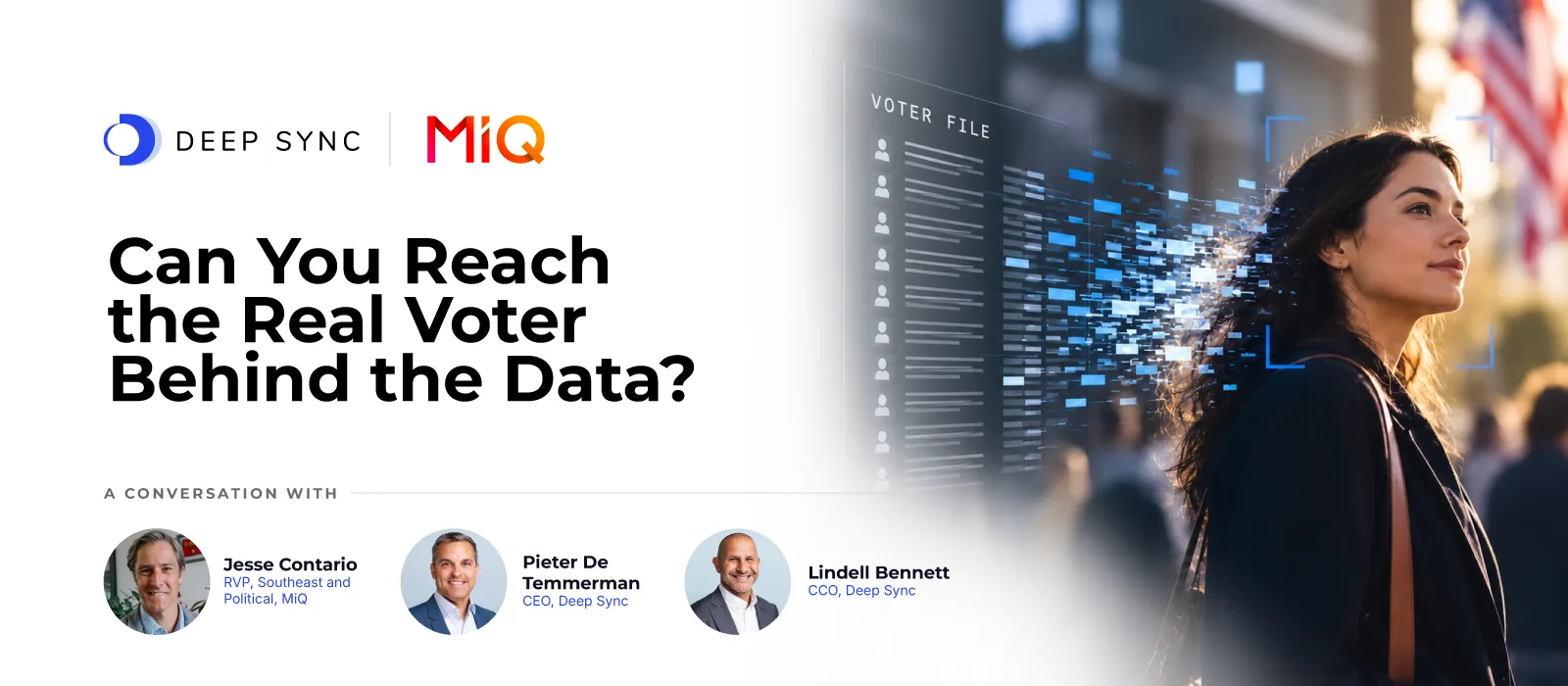
A voter file may contain millions of records, but that doesn’t mean those voters are reachable. Deep Sync and MiQ explore how identity resolution, onboarding, match rate, frequency, and measurement shape real voter reach. Featuring insights from Jesse Contario, RVP, Southeast and Political, MiQ, and Pieter De Temmerman, CEO, Deep Sync, in a conversation moderated by Lindell Bennett, CCO, Deep Sync.
A voter file can contain every voter a campaign wants to reach. That doesn’t mean every one of those voters is digitally reachable.
Political campaigns have access to more voter data than ever, but more records do not automatically translate into more people a campaign can actually reach. A campaign may know exactly who it wants to influence (a name, a postal address, a district, sometimes a phone number), yet that certainty starts to erode the moment the audience enters digital media.
CTV, digital video, programmatic display, mobile, audio, and other addressable channels do not run on voter files. They run on digital identifiers. Before a campaign can buy media against its list, those records have to become an audience that platforms can recognize. That process, voter file onboarding, is the first link in a longer chain of platforms, inventory sources, devices, and handoffs between a voter record and a delivered impression.
That gap was the focus of a September 30 LinkedIn Live conversation between Deep Sync and MiQ, moderated by Lindell Bennett of Deep Sync. Jesse Contario of MiQ and Pieter De Temmerman of Deep Sync examined why familiar metrics such as match rate tell only part of the story, and how identity decisions made upstream can eventually surface as reach, frequency, media-efficiency, and measurement problems downstream.
The stakes are especially high in political advertising because there is little room to recover lost time. Jesse noted that 55% to 70% of political media typically runs between Labor Day and Election Day. He also said he expects this cycle to be the most expensive midterm on record, likely 20% to 25% above 2022 levels. At the same time, identity and media consumption keep fragmenting across devices, publishers, platforms, and identifiers.
So the real question is not only whether a campaign has the right voter file. It is whether the identity behind those records survives the journey long enough to reach the right people where political media actually runs.
1. The voter file is only the beginning
Pieter framed the problem by separating two ideas that are often treated as the same thing: having a voter record and having a reachable voter.
A voter record does not constitute a reachable voter anymore unless the only channel you’re going to use is direct mail. […] If you’re trying to reach a voter, you’re looking at finding them digitally as well as in the more traditional channels. Digital media runs on something different from what’s in those voter records. […] Being able to bridge that gap is critical.Pieter De Temmerman, Deep Sync
That bridge is where deterministic identity resolution matters. A campaign starts with known information about the people it wants to reach and connects those records to the identifiers digital media uses, such as mobile ad IDs, CTV IDs, and hashed emails. The quality of that connection determines how much of the original voter universe remains accurate and usable.
Pieter contrasted that approach with probabilistic matching, where a record may be treated as a match because signals appear close enough. He noted that these looser matches often pull in people who were never part of the original list. Deterministic identity resolution instead connects a known record to a known person or household and to the identifiers associated with that identity.
That precision matters in politics because many target audiences are much smaller than typical commercial audiences. Pieter described political universes that may contain tens or hundreds of thousands of voters rather than millions or tens of millions of consumers. At that scale, small identity errors can become meaningful.
This is also why match rate needs context. Pieter said an 80% match rate can be a fantastic result and that anything above roughly 60% is something advertisers should be very happy with. But a percentage alone does not reveal who was matched, whether the match occurred at the individual or household level, whether household expansion was used, or which voters never became addressable.
The better question is: which voters from the original file became usable for media, and how transparently can the campaign trace that result back to the source audience?
2. Reach can disappear at every handoff
Getting the identity right is only the first test. The next question is whether that resolved voter survives the handoff into media.
Once a resolved audience enters the ecosystem, it moves across DSPs, SSPs, publishers, inventory sources, channels, and devices, and each layer can recognize a different portion of the audience. Jesse estimated that roughly 30% to 50% of the addressable internet may no longer be reachable through cookies alone. Hashed emails, mobile ad IDs, IP-based signals, CTV identifiers, and other identity signals therefore become part of maintaining addressability.
Even then, a deterministic match does not guarantee an impression. As Jesse explained, once the file goes “into the wild,” there is no guarantee of finding every voter, or of finding the same person across every device or premium environment a campaign would prefer.
That is why MiQ emphasized an agnostic, cross-channel approach across multiple DSPs, SSPs, publishers, and inventory sources rather than depending on a single platform’s identity graph. The objective is not to maximize impressions in one channel; it is to activate across the ecosystem in a way that expands effective reach while preserving the fidelity of the original audience.
And lost addressability does not always stay hidden in the data layer. It can surface in the media plan, often as too little reach and too much frequency.
3. When a media problem is really an identity problem
MiQ partners with 25 leading TV manufacturers to understand viewing behavior on those devices and analyze not only whether voters are exposed, but how often. In competitive markets, Jesse said that view can reveal a striking imbalance: roughly 20% of a voter universe may account for around 80% of linear TV or CTV political spots.
Often what we’re seeing is that 20% of the voter universe is seeing about 80% of the linear TV or connected TV spots in the ecosystem. […] There are certain voters that are literally seeing 500 ads from a political advertiser over a 30-day period, and at the same time, their neighbor might only see one. […] I don’t think the 550th ad in the month is going to really change things over the 500th.Jesse Contario, MiQ
Jesse’s recommendation was to use additional data to deprioritize voters who are already saturated and find people who have seen the ad five or fewer times, where incremental exposure may still matter.
At first glance, that can look like a media-planning issue: perhaps the frequency cap is wrong, budget allocation needs to change, or the channel mix needs work. But Pieter argued that the root cause can sit much further upstream.
That’s a very typical problem that shows up as a media problem that’s really rooted in an identity problem. So if you’re not able to match enough of the right people you’re trying to influence, what you’re having is low reach and, as a consequence, high frequency to those folks. And in fact, you might be reaching people that you’re not trying to reach at all.Pieter De Temmerman, Deep Sync
If a campaign can accurately identify only part of its intended audience, spend can naturally concentrate on the voters the ecosystem can see. Impressions pile up while meaningful reach grows much more slowly.
Average frequency can hide that imbalance. Jesse noted that a frequency cap of 10 does not prevent an average frequency of one, and that caps themselves are imperfect. The more useful view is the distribution underneath: who is seeing the message, how often, and where the campaign is underexposing or oversaturating voters.
Frequency also has to follow the campaign’s message sequence. Messaging may move from candidate introduction and biography to persuasion and contrast, and finally to get-out-the-vote (GOTV). Jesse described a scenario in which a campaign might want core voters to hear a contrast message at least seven times before the GOTV push begins.
Managing that distribution across fragmented media is where technology and human strategy meet. MiQ’s Trading Agent sits across multiple DSPs and inventory sources, consolidating frequency and performance data so traders can compare exposure across channels such as YouTube, CTV, and online video and adjust the mix accordingly. Jesse also noted that AI has accelerated this analysis, allowing traders to spend more time on strategy and less time manually stitching together platform data.
4. Speed is part of addressability
Identity, onboarding, activation, frequency, and measurement are not separate problems. They are stages of the same journey. And in political advertising, one more variable connects all of them: time.
Accuracy only matters if the audience becomes usable while there is still time to influence it. Target audiences can update every day, sometimes several times a day, as new data arrives, persuasion universes shift, and priorities change heading into Election Day.
Speaking on September 30 with 34 days left before Election Day, Jesse pointed out that even a five-day onboarding timeline would consume roughly 15% of the remaining window. At that stage of a campaign, the difference between same-day activation and waiting several days is not merely operational; it changes how much time is left to reach and persuade voters.
It needs to be same day or, worst-case scenario, next day.Jesse Contario, MiQ
Pieter shared the example of Trilogy, which had been working with multiple onboarders but could not get updated audience data live quickly enough. Through Deep Sync, he said, its audiences were onboarded in under an hour.
He also cited Push Digital, which had struggled to find enough of its relatively small audiences online and saw a 130% lift in the audience it could target digitally after working with Deep Sync. More broadly, Pieter said political advertisers working with Deep Sync typically see around a 25% increase in their ability to match the voters they are targeting compared with other onboarders.
The point is not simply that the audience gets bigger. It is that more of the intended universe becomes usable for media while the campaign can still act on it.
The electorate itself is not static either. Pieter described using near-real-time mover data to identify voters who have left a district, where continued spend may no longer be relevant, and people who have recently moved in and may be worth reaching. When the persuadable audience is already narrow, keeping that universe current can matter as much as expanding it.
5. Close the loopMatch ≠ Reach ≠ Efficacy
The final step is measurement. A campaign that starts with a defined target universe should ultimately be able to understand who was matched, who was exposed, and who engaged, and connect those signals back to the original audience.
Pieter emphasized closed-loop measurement as a way to examine whether the campaign is reaching the intended households and individuals. If people appear downstream who were never part of the target audience or an associated household, that can be a signal to examine the identity-resolution process more closely.
That progression is the real story: a matched voter is not necessarily reachable. A reachable voter does not necessarily receive an impression. And a reached voter does not necessarily hear enough of the right message, at the right time, to influence an outcome.
Match rate doesn’t equal reach rate. […] Reach doesn’t equate efficacy. […] Driving 1%, 2%, 3% incremental reach among a core voting bloc in these swing states, in these battleground states, is really meaningful right now. We’re going to see some of these races come down to half a percentage point or less.Jesse Contario, MiQ
In a race that may come down to half a point, a match rate that looks great on a dashboard matters less than the voters it actually puts within reach. The real question is not how many voter records a campaign started with, or even how many matched. It is how many of the right voters became reachable, received the message, and remained actionable while there was still time to influence the outcome.
That is the gap between having voter data and actually reaching the voter behind it.
Watch or listen to the full conversation
This article captures the central themes from Deep Sync and MiQ’s LinkedIn Live conversation with Jesse Contario, Pieter De Temmerman, and Lindell Bennett. The full discussion, now available on YouTube and Spotify, goes deeper into deterministic vs. probabilistic matching, match-rate transparency, cross-channel activation across DSPs and SSPs, CTV, frequency strategy, closed-loop measurement, onboarding speed, mover data, and incremental reach.
Julia is Director of Product Marketing at Deep Sync, specializing in identity resolution, customer data, audience activation, and go-to-market strategy. She helps brands turn complex data into actionable insights that power better marketing, personalization, and customer engagement.
Let's connect →