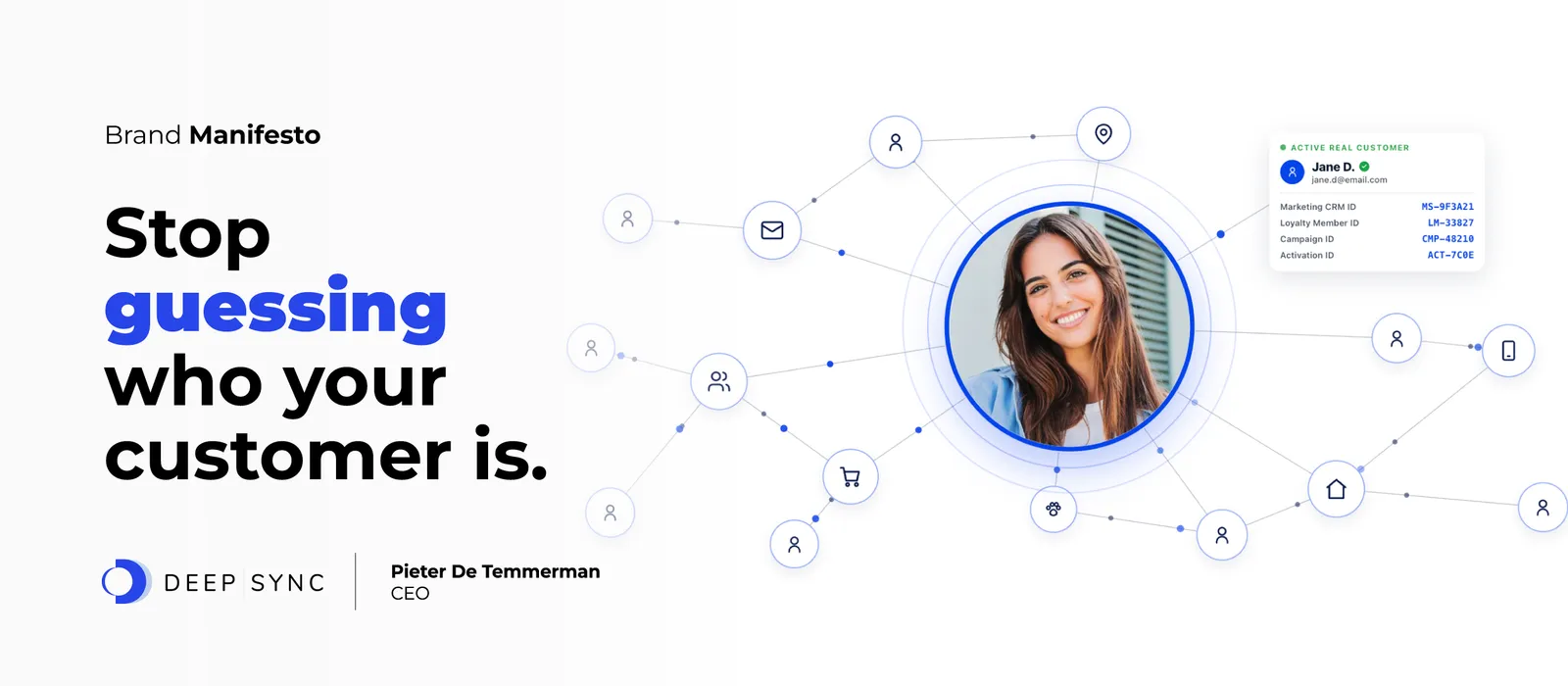
Deep Sync CEO Pieter De Temmerman introduces a new era for Deep Sync, built on one simple conviction: stop guessing who your customers are, start knowing! A manifesto on why deterministic identity is the foundation for understanding real customers, connecting their journeys, and building better audiences, interactions, and outcomes.
There has never been more customer data, and there has never been less certainty about who it belongs to. Every person leaves a trail behind them: a transaction, an email address, a device, a household, a store visit, a purchase made offline and never counted online. Organizations collect thousands of these signals every day, across systems that were rarely designed to talk to each other. Collecting has never been the hard part.
The signals multiply. The picture doesn't.
The gap that exists in connecting this data to inform and drive timely business outcomes costs more than most companies realize, because everything downstream gets built on top of it. Fragmented and stale data turn into a murky understanding of the customer, and results in weaker decisions, and, eventually, a real budget and resources are being expended targeting incorrect or irrelevant customers.
You can't personalize your way out of that, and you can't model your way out of it either. AI doesn't fix bad data, it amplifies it…every prediction, every audience, and every insight inherits the quality of whatever sits underneath it, which means a weak foundation doesn't stay a data problem for very long. It becomes a marketing problem, and then quickly a revenue one.
The cost isn't a disappointing quarter. It's a company that is missing out on a relevant and timely dialog with its own customers.
Identity is the solve.
Near real-time and accurate identity resolution at scale is what connects customer data to business outcomes. I believe deterministic identity is the foundation everything else stands on. Not a step in the stack, and not a feature in a platform - every insight you generate, every audience you build, every impression you buy, and every outcome you measure rests on one question that has to be answered correctly before the rest of it means anything.
Who is this, actually?
For too long, identity has been treated as one step in a much larger marketing process. Companies clean their first-party data with one provider, enrich it somewhere else, resolve identities through another system, find audiences through another marketplace, and rely on still more technology to activate those audiences across channels.
Each solution might solve an individual problem, but customers don't experience brands as a collection of systems, identifiers, or channels. They move between them!
The same person might appear in a CRM, visit a website, make an offline purchase, interact with an ad on another device, or interact with a customer service representative. To the marketer, those interactions look like disconnected signals, to the customer, they're simply different moments in the same relationship.
Your customers don't separately live in an online world or an offline one
They might discover you through a digital ad, browse your website, receive a catalog, walk into a store, and buy something weeks later without ever connecting any of it. To them, it's one continuous relationship rather than a series of disconnected touchpoints, the separation only exists on your side.
Your customer strategy should reflect the customer's view of it - the most effective audience strategies don't separate online from offline. They start with a complete understanding of the customer, then activate that same customer understanding wherever it's most relevant, from digital advertising to direct mail to outcome based measurement, and everything in between.
That's where identity becomes the difference. When every channel is built on the same trusted customer foundation, your digital campaigns become more relevant, your direct mail becomes more precise, and every interaction works together instead of competing for the attention of a person the two channels don't realize they share.
Your customers don't live in an online world or an offline one. They live in both, and the best marketing recognizes the same person across every channel. So, identity shouldn't be another isolated step in the marketing stack, it should be the layer that connects the entire journey.
What we're not willing to accept.
Which is why we reject the guess.
We reject probability dressed up as precision, and black boxes that ask for trust while offering no evidence. We reject the assumption that more data will eventually add up to more understanding, because it never has, and because scale has never once been a substitute for accuracy.
Deterministic identity is also the only kind you can actually explain, where the data came from, how the match was made, and why it holds. That's why privacy is a design decision for us rather than a compliance exercise bolted on at the end: we know the provenance of our data because we own it, consent is documented rather than assumed, and opt-out requests are honored and easy to find. Accuracy and privacy aren't in tension, they come from the same discipline.
A match you can't verify was never a match, It was a hope with a confidence score attached!
What this should look like instead
An identity layer that enables a marketer to understand the real people behind its data from first to last touchpoint. Where understanding survives the trip from the CRM to the channel, where the identity you resolve is the identity you reach, in a mailbox or on a screen, and it is the same person at every step. Channels change. Identity shouldn't!
The new Deep Sync brings that vision to life with a clearer position and a portfolio built around one idea: identity should connect your Company to your real customer.
We are the deterministic identity layer underneath the customer journey, built over 35 years on data we own and can stand behind. And we don't borrow conviction from someone else's identity graph, and we don't ask anyone to take a match on faith…We see people!
Our new portfolio and era are organized around the outcomes our customers are actually trying to reach, rather than the products we happen to sell.
- Know Your Customers, because you can't act on data you can't trust. It starts with the first-party data you already have: clean it, enrich it, understand it, and build a foundation worth building on.
- Resolve Identity, so the fragments become one real person. Deterministic identity resolution connects records through verified relationships rather than statistical assumptions, turning scattered identifiers into one unified customer view across people and households.
- Reach New Audiences, the real people you haven't met yet. Third-party audiences, lookalikes built from verified seeds, predictive models, and rich attribute data extend that understanding beyond your existing base.
- Use Audiences Across Channels, with an identity that survives the handoff. Audience activation across digital, CTV, social, and offline channels like direct mail, without losing the foundation it was built on.
These aren't four separate problems, they're four parts of the same journey, and each one makes the next one better. Knowing your customers improves how you resolve identity. Better identity produces better audiences. Better audiences make activation more relevant - and activation creates new signals that deepen what you know next.
Deep Sync's evolution goes beyond a new website. It's about how we define our company, communicate what we stand for, and bring our solutions together around a clearer idea of the value we deliver.
Whether you're trying to understand the customers you already have, connect fragmented signals, find the people most likely to become customers next, or reach an audience across digital media and direct mail, it all begins with the same question: do you actually know who you're trying to reach?
We are not in the business of more, we are in the business of truth. Stop guessing who your customers are. Start knowing!
See the new Deep Sync in action.
Explore the four-stage portfolio and the solutions behind each one, from understanding your customers to activating them everywhere.
Pieter leads Deep Sync's strategy and operations, rebuilding the company around deterministic identity.
Let's connect →