

Imagine you run a furniture company. Your customer, Lauren, recently moved and has been browsing online for new furniture. How can your business ensure these online and offline actions are attributed to the same customer?
The answer lies in a comprehensive identity graph. Without one, Lauren’s online and offline activity may be disparate and not accurately attributed to a holistic customer profile. However, with an identity graph, all of these actions (and any subsequent actions or other identifiers) will be connected to her single customer identity, enabling your company to personalize Lauren’s experiences with your brand and more precisely map her conversion journey.
Most companies struggle to do this on their own. By leveraging an identity graph from an identity services provider, businesses can connect online and offline identifiers, improving outreach and informing future campaigns.
In this guide, we’ll explore identity graphs and their importance by answering the following questions:
- Identity Graph FAQs
- How does an identity graph work?
- How are identity graphs built?
- What are the benefits of leveraging an identity graph?
- Why are identity solutions important right now?
- How should my business proceed with choosing an identity graph solution?
We’ll start by defining identity graphs, then enhance your understanding of them and help you integrate them into your marketing strategy.

Identity Graph FAQs
What is an identity graph?
An identity graph is a foundational data asset that connects and unifies consumer data from multiple touchpoints, devices, and platforms to create a single, consistent, and persistent profile of each individual consumer.
It links disparate identifiers, data points, and signals to a single individual or household, enabling marketers to understand who their customers are across different channels and deliver personalized, targeted marketing.
Identity graphs can include offline and online identifiers, such as:
- Offline: Names, Postal Addresses, Phone Numbers, Email Addresses
- Online: Mobile Ad IDs (MAIDs), Unified ID 2.0 (UID2), Hashed Emails, IP Addresses

As the scenario presented illustrates, it’s not enough to have the right data. You must piece disparate data points together to make them actionable. With an identity graph, the furniture company could view all of Lauren’s actions as belonging to her, enabling them to understand what led her to convert and personalize communications. Identity graphs help break down data silos to give your business a single, unified view of its customers that facilitates relevant marketing campaigns.
What is the difference between an identity graph and a knowledge graph?
While identity graphs and knowledge graphs work similarly, they serve different functions. An identity graph focuses on linking identifiers to a specific person, household, or business. A knowledge graph, on the other hand, maps semantic relationships between broader entities, facts, and concepts.
In short, an identity graph answers the question, “Who is this user?”, while a knowledge graph answers the question, “What is this concept?”
What is the relationship between identity graphs and identity resolution?
Identity graphs power identity resolution, which is the process of uniting the disparate identifiers found in a dataset to form unified customer profiles.
Businesses use identity resolution to:
- Understand customers to a deeper degree across more attributes.
- Pinpoint target audiences for marketing campaigns.
- Customize marketing messages and materials to different audiences.
- Integrate online and offline data to reach customers across channels.
- Develop consistent messaging across customer touchpoints.
- Attribute actions back to individual customers.
- Manage ad frequency and reduce wasted ad spend.
Deep Sync’s industry-leading identity graph is built from a comprehensive database of over 270 million U.S. consumers and covers 97% of U.S. consumers over 18. It contains three dimensions to resolve identities as precisely as possible:
- Personal information from our proprietary identity spine that includes consumer names and postal addresses
- Online identifiers linked to known individuals and households in a privacy-compliant manner using Deep Sync IDs
- Data attributes, including demographic, firmographic, lifestyle, property, and geographic information
What truly makes Deep Sync’s identity graph stand out and facilitate more accurate identity resolution is its roots in offline, deterministic data. Let’s explore what this means and why it’s so important for resolving identities.
What is the difference between probabilistic and deterministic matching?
Probabilistic matching relies on predictive algorithms and heuristics to resolve customer identities. Considering these algorithms produce educated guesses based on the information at hand, they have a wide margin of error and aren’t always accurate.
On the other hand, deterministic matching connects online identifiers based on authenticated data to confidently resolve known profiles to real-world individuals and households. This method uses higher-fidelity matching based on observed or shared identifiers to map data points to individual profiles only when there is a determined match, enabling more accurate identity resolution.
Since Deep Sync’s identity graph is built on offline, deterministic data, it enables accurate, reliable identity resolution and empowers businesses to target and engage customers more efficiently and effectively.
Explore the difference between probabilistic and deterministic matching using the interactive slider below:
Probabilistic Matching
Identity guessed from weak signals.
Guess
Deterministic Matching
Identity verified with authenticated data.
Deep Sync ID
How does deterministic matching work?
The core of deterministic matching is online and offline data collection. By combining your first-party data with the personal information and data attributes of an identity graph, you and your data provider create a foundation for deterministic identity resolution, in which the graph uses known identifiers like email addresses or phone numbers to match customer interactions across touchpoints.
Then, advanced algorithms and machine learning match and link data from different sources to a single customer ID. There are several different forms of matching logic that algorithms use to connect customer data points, including:
- Email address match, which might link a logged-in web session and a mobile app session tied to the same email address
- Phone number match, which may link a customer phone call and SMS opt-in to the same phone number
- Loyalty program ID, which links in-store purchases and online shopping history to the same loyalty account number
- Account login, which merges multiple devices and sessions with a single authenticated account login
- CRM record match, which can link offline sales representative interactions and digital campaign responses through a shared customer ID in your CRM
- Device ID and known user tie-in, which links a logged-in customer to the mobile device they use across sessions
At the end of the process, you receive Single Customer Views (SCVs) that consolidate all known data about individual customers across touchpoints, enabling you to personalize experiences at scale. Just keep in mind that each data provider has its own unique matching logic.
How does an identity graph work?
An identity graph is a type of graph database. Unlike the relational databases used by CRMs and basic CDPs, which structure data in tables, graph databases store relationships among data points. As a result, the database doesn’t have to search through tables to find connections, enabling the graph to quickly query these relationships. Since identity graphs are intended to connect related user data points, this framework supports their functionality.
To accomplish this goal, identity graphs have three foundational components:
- Nodes, which are individual data points (in this case, the online and offline identifiers found in the identity graph)
- Edges, which are lines that connect the nodes and represent the relationships between identifiers
- Properties, which are metadata attached to the nodes and edges to describe them, such as a timestamp or confidence score
Let’s say a new customer makes a purchase on your website. When they enter their shipping and email addresses at checkout, your identity graph will create an edge between these two data points (or nodes) and attach any relevant properties.
How are identity graphs built?
Here is the typical process data engineers follow to build an identity graph:
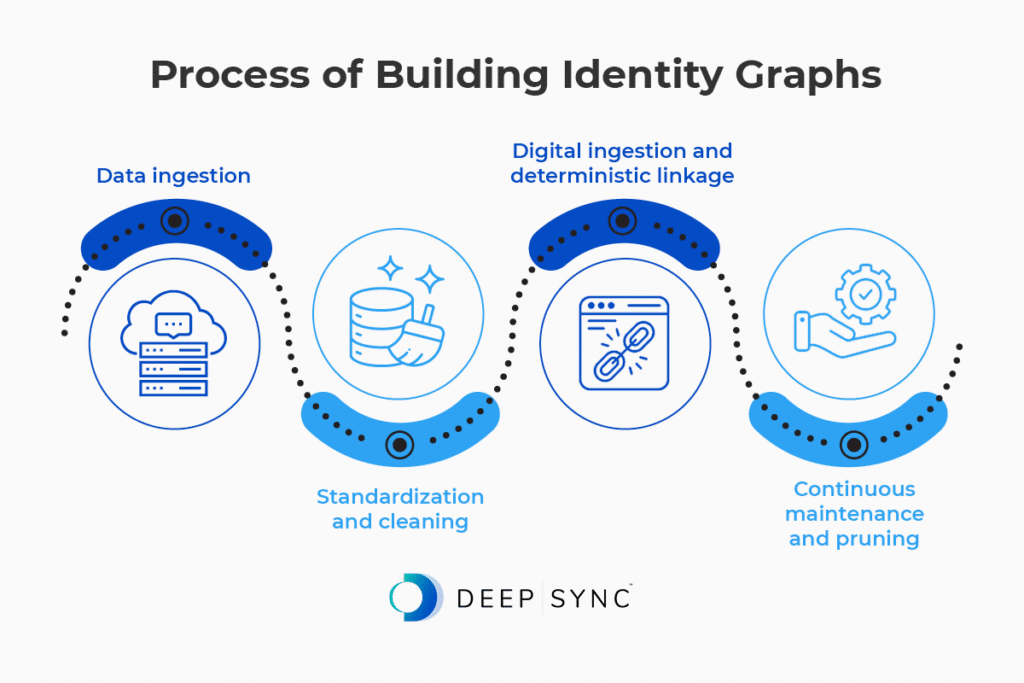
- Data ingestion. The identity graph building process begins by collecting authoritative offline data on a national scale. This data may come from sources like public registries, utility records, voter files, credit data, and historical real estate files.
- Standardization and cleaning. To ensure easy matching between data points, the data must be normalized. During this stage, special characters are stripped, phone numbers are standardized, address typos are resolved, and any fake or spam data is removed. In Deep Sync’s case, this information becomes our core identity spine, establishing a clean, verified truth set of 270 million U.S. adults and 97% of households.
- Digital ingestion and deterministic linkage. With the offline data securely in place, the data engineering pipeline is ready to ingest digital identifiers, such as MAIDs, Hashed Emails, and UID2. From there, the graph draws connections (or edges) between digital signals and the identity spine based on authenticated actions or relationships, such as a secure user login.
- Continuous maintenance and pruning. To keep the identity graph data up to date, algorithms monitor the edges and remove any that are no longer active. Additionally, Deep Sync’s identity graph updates weekly with fresh offline data using high-quality data sources to ensure accuracy.
What are the benefits of leveraging an identity graph?
When you use an identity graph to resolve customer identities, your business will receive the following benefits:
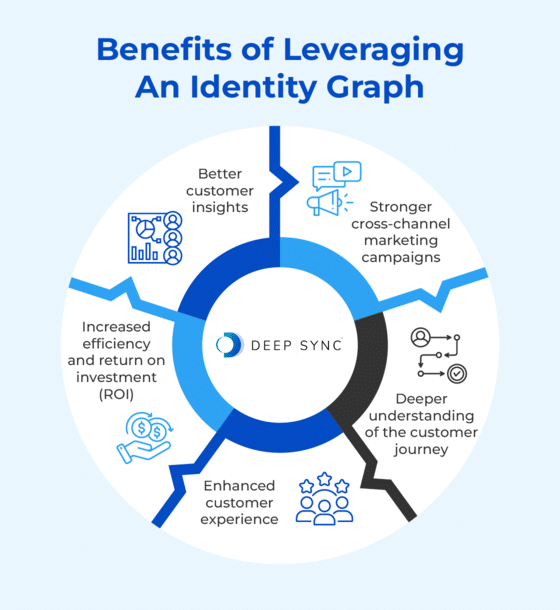
- Better customer insights. Uniting customer data points gives you a fuller picture of each individual customer. As a result, you can customize your offerings and messaging, target customers more precisely on the channels they use, and segment them for even deeper personalization.
- Stronger cross-channel marketing campaigns. The more touchpoints you have with potential customers, the more familiar they’ll become with your brand and, therefore, more likely to make a purchase. Identity graphs power consistent cross-channel marketing so you can serve cohesive, relevant messages across channels that boost conversions.
- Deeper understanding of the customer journey. Since identity graphs combine online and offline data, you can better understand how customers engage with your business. This information allows you to optimize the customer journey to meet their needs at every stage and predict future customers’ paths to conversion.
- Enhanced customer experience. Customers who receive more relevant content from your business will have a more positive experience with your brand. Consequently, they’ll be more likely to remain loyal to your company, engage with your business frequently, and recommend your products and/or services to others.
- Increased efficiency and return on investment (ROI). Identity graphs make it easier to personalize your marketing efforts at scale and reap the benefits. Personalized marketing campaigns can reduce customer acquisition costs by up to 50% and boost revenue by 5-15%, increasing overall ROI by 10-30%.
Incorporating identity graphs into your marketing strategy is a win-win situation. While your customers receive more personalized, relevant messages that speak to their needs on the channels they frequent, your business will have the data it needs to constantly innovate, find new ways to increase sales, and boost ROI.

Why are identity solutions important right now?
Third-Party Cookie Instability
While personalized marketing is always valuable for businesses, identity graphs and identity resolution have never been more critical. Third-party cookies have long been in flux, and their future is increasingly unclear.
Google’s latest update on the issue includes a new opt-in model that many in the industry fear will push privacy-conscious consumers to reject cookies altogether. In fact, experts predict that 70-80% of Chrome users will opt out of cookies.
No matter your stance on Google’s approach, it’s evident that marketers can no longer rely on third-party cookies for targeting and need to invest in more stable strategies for reaching and engaging their target audiences.
Since Deep Sync’s identity graph links online and offline data and updates to align with consumer life changes, it’s a reliable source of truth for audience targeting and engagement that doesn’t depend on third-party cookies. Leveraging an identity graph enables you to future-proof your marketing strategy and remain confident in your ability to reach your audience.
Data Privacy Concerns
Additionally, data privacy is a growing concern among consumers, with 75% claiming they will not purchase from companies they don’t trust with their data. Identity solutions are a privacy-conscious way to understand and engage customers.
Deep Sync’s identity graph uses persistent identifiers to help maintain data integrity while remaining privacy-conscious. We store offline data separately from online data and enable linking this information to pseudonymized individual IDs.
Our approach ensures that you use data in a secure and privacy-compliant manner, allowing brands to better understand and reach their audiences while respecting consumer data protections. In addition, Deep Sync meets, if not exceeds, all applicable consumer privacy requirements, and opt-outs are accepted from every state and are universally applied as “Do Not Sell” requests.
How should my business proceed with choosing an identity graph solution?
While an identity graph is a powerful tool for better understanding your customers, not every identity graph functions the same. Before deciding on an identity graph solution, answer the following questions:
- Are you looking for signal resolution or true identity resolution? While signal resolution links identifiers to a common profile, identity resolution takes this process a step further by connecting identifiers to a known person or household. Ultimately, identity resolution is more complex, enabling more actionable customer insights.
- Which is more important: scale or accuracy? If you want to maximize reach and spread brand awareness, you may opt for scale. Alternatively, if you want to reach a specific audience, a precise, highly accurate model is best.
- How much control would you like over the identity resolution process? For teams with more identity expertise, a flexible, modular identity solution will give you more control. However, if you lack expertise—or perhaps lack the resourcing to execute identity resolution on your own—then letting a trusted provider handle your identity resolution needs end-to-end might be a better option for you.
- How does your potential provider develop its identity graph? Ideally, your provider will base their identity graph on high-quality, offline data sources. They’ll use a deterministic approach that allows you to be confident in the insights they provide because they resolve back to real people and households.
- Is your first-party data clean and ready to be used? Before implementing an identity strategy, ensure your data is clean to maximize its value. Consider working with a provider that offers additional data services—including data hygiene—so you can work through the entire process together.
Clarifying your business’s needs for an identity solution will focus your efforts on finding the right provider and ensure you leverage an identity graph to propel your goals forward.
Access The Most Comprehensive Customer Identity Graph
A high-quality identity graph is the key to gaining a full understanding of your customers and effectively targeting them. With Deep Sync’s identity graph and identity resolution services, you can create marketing messages that resonate with your audience and, as a result, increase your bottom line.
If you’re ready to partner with Deep Sync and get started with identity resolution services, book a strategy session so we can explore your data needs and develop a solution together.
To learn more about identity solutions before adopting them, check out these resources:
- What Is Identity Resolution? The Ultimate Marketer’s Guide. Identity graphs facilitate identity resolution. Explore the identity resolution process and the benefits it can provide for your business.
- Understanding Deterministic Identity: The Key to Effective Marketing. Deep Sync’s identity graph stands out due to its deterministic data. Learn more about deterministic identity and how it boosts ROI.
- Cookie Instability and the Need for Durable, Interoperable IDs. As third-party cookies remain unstable, reliable targeting solutions are necessary. Dive deeper into interoperability and how to pivot your data strategy in the face of cookie instability.










0 Comments