

Lookalike audiences provide an effective way to target new prospects and expand your customer base. However, many teams lack the bandwidth and data expertise to create these high-performing target audiences on their own.
Outside of platform-specific tools, lookalike modeling can seem daunting. That’s why we recommend outsourcing your modeling for maximum impact. With the right tools, you can build and deploy lookalike audiences across multiple channels—without having to build the models in-house.
In this guide, we’ll dive deeper into what you need to know about lookalike modeling and how to get started:
- Lookalike Modeling FAQs
- Deterministic vs. Probabilistic Lookalike Modeling
- How to Get Started with Lookalike Modeling
- Leveraging Lookalike Modeling with Deep Sync

Lookalike Modeling FAQs
What is lookalike modeling?
Simply put, lookalike modeling is the process of creating a lookalike audience, which is an audience of new prospects that mirrors your existing customer base. These potential customers share behavioral and demographic characteristics with your current customers, making them more likely to be interested in your offerings.
What are the benefits of lookalike modeling?
Lookalike modeling can significantly improve your marketing efforts, especially when you have greater control over the process. Here are some of the top benefits:
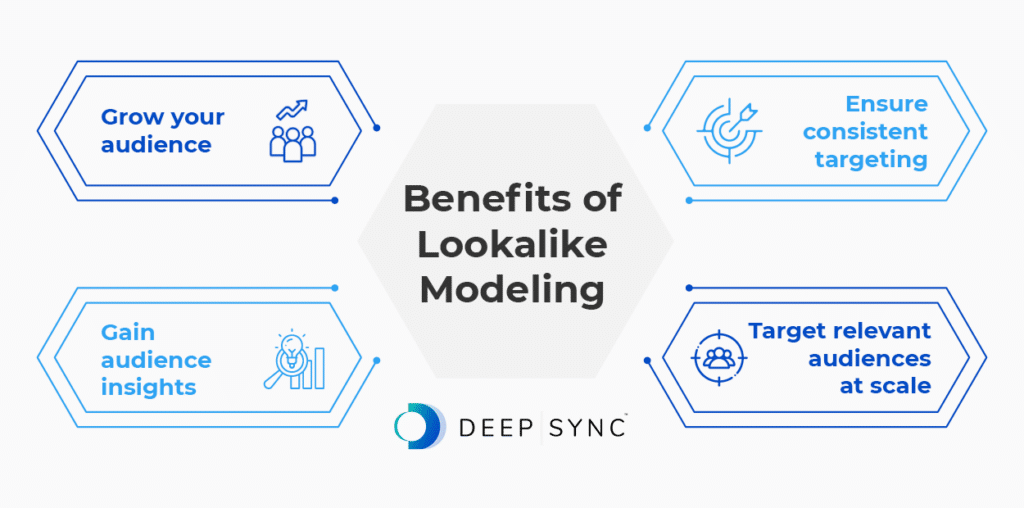
- Grow your audience. Demographic lookalikes that use your customer data as a seed for modeling help grow your advertising efforts while maintaining the quality of your audiences. This process helps you identify high-value prospects, resulting in improved lead generation, reduced marketing spend, increased conversions, and better return on investment (ROI).
- Ensure consistent targeting. A portable lookalike model, in contrast to a platform-specific one, prevents lookalike lock-in, where audiences are usable only on that platform. Lookalike lock-in limits advertisers’ ability to gain a unified understanding of their audiences and apply insights beyond a single social or programmatic platform—resulting in higher costs, redundant learning, and reduced omnichannel impact. A portable lookalike model helps avoid these issues by enabling consistent targeting across multiple channels.
- Target relevant audiences at scale. Lookalikes created outside of a walled garden are portable, enabling brands to accurately and confidently target the right audiences at scale across multiple destinations. For example, social media lookalike audiences built on Deep Sync One can be targeted across Meta channels like Facebook and Instagram, as well as TikTok. This portability increases the likelihood that prospects will convert over time since the ads will reach them across disparate channels.
- Gain audience insights. Depending on how the lookalike model is created, the process can provide insights about the key demographics, interests, and behaviors of your most valuable customers. This information helps you better understand your customer base, inform future decisions, and identify who is most likely to convert.
Additionally, opting for lookalike modeling over platform-specific lookalike models typically enables you to better customize your audiences to meet campaign requirements. For example, some lookalike modeling tools, including Deep Sync’s offline lookalike audience tool SnapShot, enable geographic and demographic prioritization for further customization.
What is a seed audience in lookalike modeling?
A seed audience is the initial list of first-party customer profiles you feed into the machine learning algorithm. The model analyzes the traits of this seed group to find new, demographically similar prospects outside your current audience. For the best lookalike modeling results, your seed audience should consist of your highest-value buyers rather than just broad website visitors, ensuring the algorithm optimizes for profitable customers. Seed audiences can also be generated from your best donors, subscribers, or supporters.
How does lookalike modeling work?
The lookalike modeling process uses your customer data as a seed for modeling. Different algorithms use this information in different ways to inform audience building.
For example, Deep Sync’s process uses AI and machine learning to generate demographically focused consumer profiles, enabling matches between your data and our deterministic identity graph. These profiles are then used to inform the selection of consumers in our prospect universe with demographic and/or geographic similarities—giving you the ideal lookalike audience.
Is lookalike modeling a one-time process?
Typically, lookalike modeling is not a one-time process. To maintain high performance and low acquisition costs, lookalike modeling must be an ongoing, dynamic part of your marketing efforts.
Many marketers make the mistake of treating lookalike audiences as a “set it and forget it” tactic, uploading a static list of customers and running campaigns against that same model for months. However, this method often leads to model decay. As your business launches new products, enters new markets, or experiences seasonal shifts, the profile of your ideal customer changes—and so should your lookalike audiences.
To keep your lookalike audiences fresh, regularly update your seed data so the algorithm has the most up-to-date information possible on your customer base. That way, you can ensure you’re targeting the consumers who most closely match your current customers at any given moment.
Deterministic vs. Probabilistic Lookalike Modeling
The success of your lookalike model relies on the accuracy of the underlying data. While you have control over your seed data, the algorithm you use will also pull its own data to identify which potential customers are most similar to your customer base.
There are two different approaches platforms use to resolve identity and build lookalike audiences:
- Probabilistic modeling. Probabilistic models rely on predictive algorithms and heuristics to predict who might respond well to your marketing efforts. Traditionally, these models use third-party cookies to track user behavior, which many users opt out of to protect their privacy.
- Deterministic modeling. On the other hand, deterministic models use authenticated data to identify consumers who align with your current audience. They remove the guesswork by anchoring lookalike modeling in real demographic, behavioral, and geographic attributes that reflect your customer base.
Deep Sync uses deterministic modeling, matching your seed data against our identity graph that covers 97% of U.S. consumers. We root our process in verifiable data, so your lookalike audiences contain real people who are likely to be interested in your offerings.
How to Get Started with Lookalike Modeling
Building a high-performing lookalike audience requires more than just pushing a button in a modeling platform. To ensure your campaigns drive true ROI, you need a strategic approach to prepare your data. Start your lookalike modeling process off strong by following these steps:

- Clean your first-party data. To ensure the best possible results from your lookalike modeling process, your seed data should be accurate and ready to use. Clean your data by standardizing addresses, running National Change of Address (NCOA) updates, and removing duplicates or outdated records.
- Segment your data. Identify your best customers by digging into your database and grouping them according to their similarities. That way, you can build your lookalike audience to model high-value customers rather than every contact in your database. For example, excluding inactive users or those who haven’t made a purchase will improve audience quality.
- Choose your parameters. Once your seed audience is ready, you must decide how broadly you want the algorithm to cast its net. This is known as audience sizing, and it requires balancing precision against reach. For example, a 1%-3% lookalike audience has higher precision but lower reach, making it ideal for bottom-of-the-funnel direct response campaigns. Alternatively, a 5%-10% lookalike audience has a broader reach but lower precision, which is better for top-of-funnel awareness campaigns.
- Upload your data. After you’ve optimized your data, we recommend working with a data provider; their expertise can be incredibly helpful in building these high-performing audiences. Depending on the provider’s options and your preference, you’ll either manually upload your data, typically as a CSV or TXT file, or conduct the process within your own secure cloud environment.
Leveraging Deep Sync for Lookalike Modeling
With Deep Sync’s lookalike modeling capabilities, the possibilities are endless. Explore how you can use Deep Sync’s various lookalike modeling tools to target your ideal audience across channels.
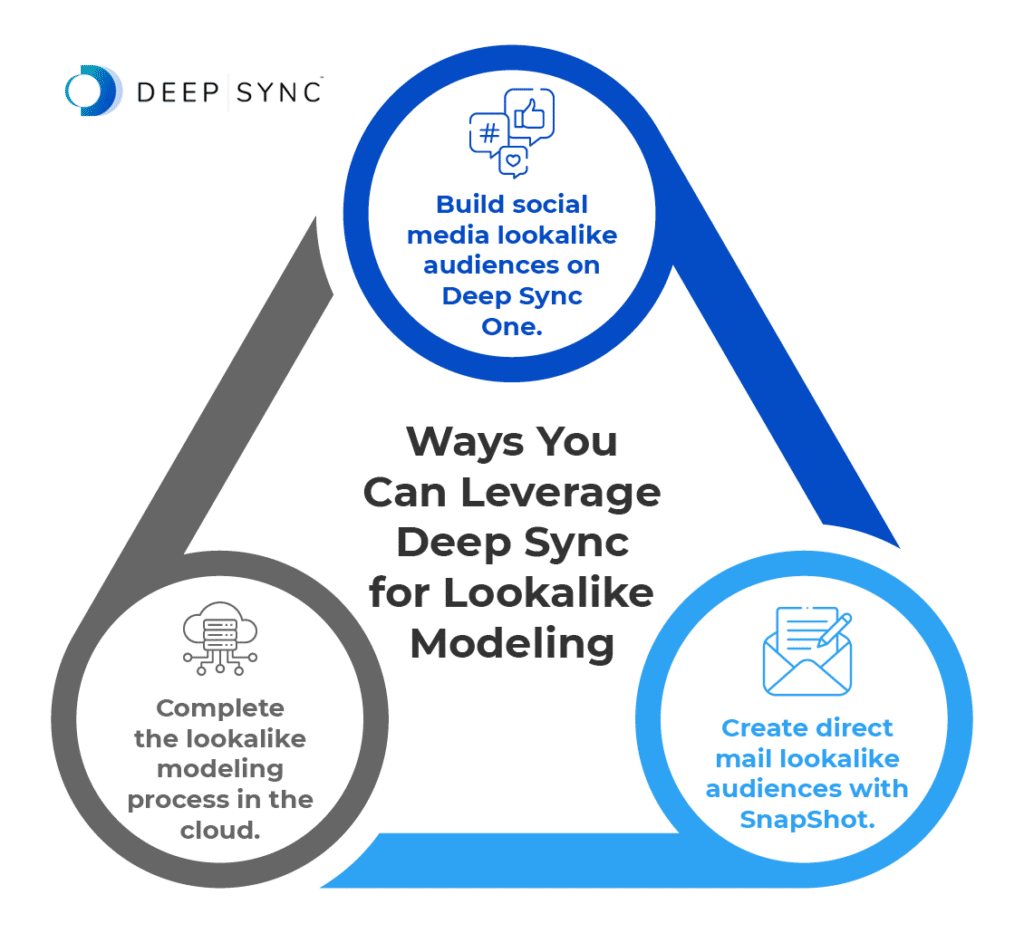
Build social media lookalike audiences on Deep Sync One.
Lookalike audiences on Deep Sync One are built using AI and machine learning to generate demographically focused consumer profiles, enabling matches between a brand’s first-party data and our multi-dimensional, offline-to-online identity graph.
These custom on-demand audiences, informed by the intelligence within your current customer data, are extremely easy to create. Simply upload your data and let Deep Sync One do the rest! Once you have your audience, you can customize its size to meet your specific campaign requirements. Simply make a free Deep Sync One account to get started.
Create direct mail lookalike audiences with SnapShot.
SnapShot on AccuLeads uses the intelligence of your data to quickly create a custom prospect audience of demographic lookalikes for direct mail campaigns.
This automated service profiles your best customers by matching your first-party data to a comprehensive database of U.S. consumers or businesses to create a customized market penetration analysis. The resulting report serves as the foundation to create fully customized lookalike audiences.
You can further customize the audience by selecting desired demographics, such as ZIP Codes, U.S. states, income brackets, and more. Additionally, you can add email addresses and phone numbers to expand touchpoints to other channels. Learn more about SnapShot in this Product Sheet.
Complete the lookalike modeling process in the cloud.
Deep Sync’s Lookalike Audience Native App, available in Snowflake, enables you to create high-quality audiences that demographically resemble your best customers. Using your first-party data as a seed for modeling, the app matches records against Deep Sync’s deterministic identity graph—built on over 270 million direct mail-grade consumer profiles.
This process generates modeled audiences by identifying individuals within the prospect universe who have similar demographic attributes and are geographically closest to your current customers. A key benefit of this solution for Snowflake customers is that the data never leaves the secure Snowflake environment.
Use Lookalike Models to Power Your Marketing Efforts
Lookalike modeling makes it easier than ever to identify consumers who are similar to your current customers and expand your reach. When you prepare your data and select the right data provider, you can be confident that your lookalike models accurately reflect your current audience and will power future growth.
Ready to get started with lookalike modeling? Contact us today, and one of our data experts will be in touch to help you build the perfect lookalike model for your marketing campaigns.
To learn more about lookalike audiences, explore the following additional resources:
- AI Lookalike Audiences: A Complete Guide. Explore how data providers use AI to streamline the lookalike audience modeling process.
- Lookalike Audience Lock-In. Dive deeper into the phenomenon of lookalike audience lock-in and how portable models can solve it.
- How Lookalike Audiences Can Fuel Omnichannel Campaigns. Learn more about how lookalike audiences can power your omnichannel marketing campaigns.









0 Comments