
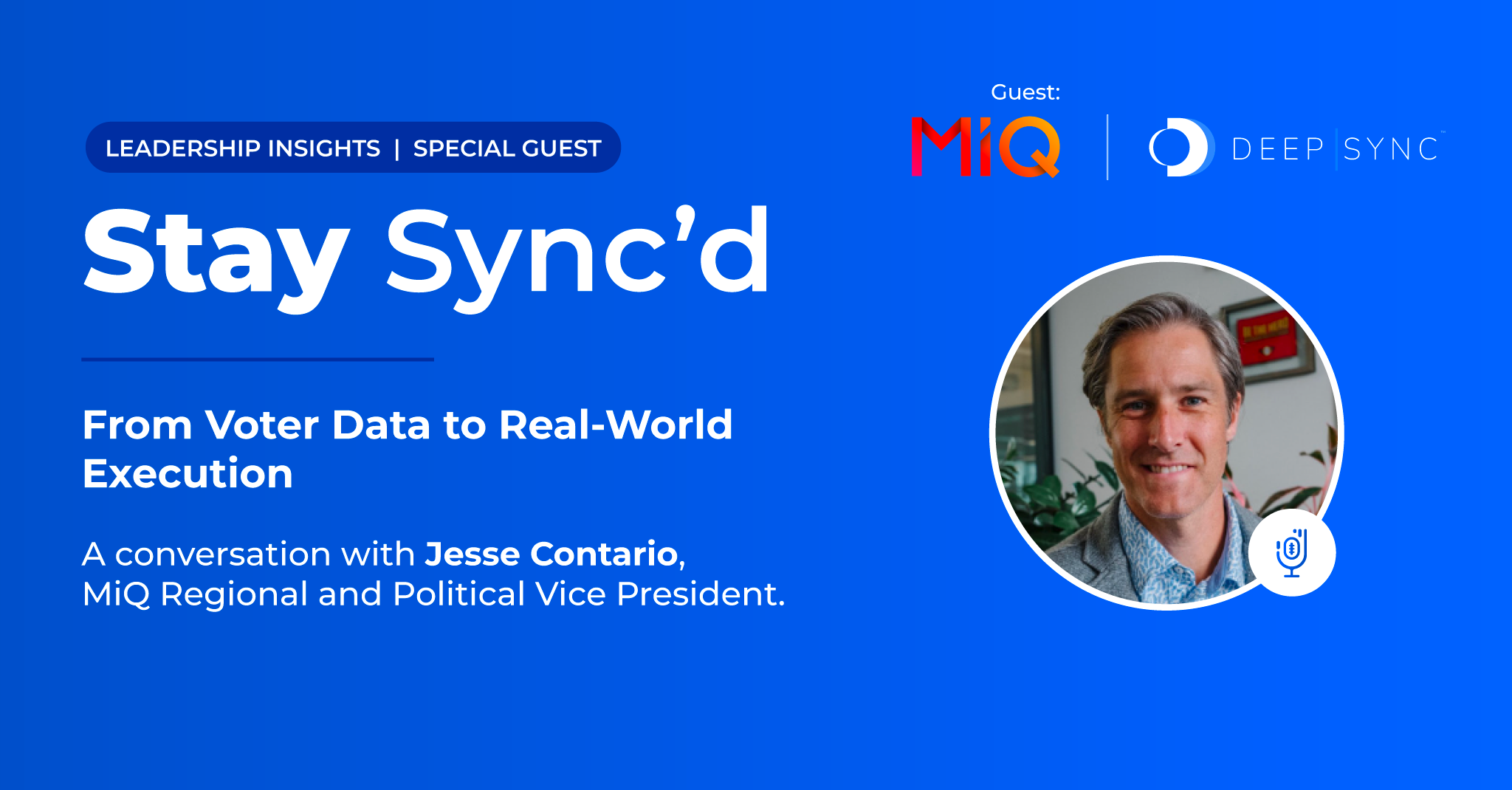
Voter data media activation is where political campaigns lose control, and where 2026 will be decided.
Jesse Contario has spent nearly 15 years watching political campaigns plan brilliantly on paper and then lose control the moment data moves into media. In this conversation, the MiQ Regional and Political VP explains where the system breaks, who’s winning despite it, and what it takes to carry a clean identity signal from voter file to live media before 2026 cycle.
There’s a moment in almost every political campaign when confidence turns to confusion.
The gap between data and execution, the one every campaign feels, doesn’t really sit in one place. It shows up in the in-between: between planning and activation, between data and media, between what you expected to happen and what actually does.
The voter file looks solid. The targeting strategy makes sense. The media plan is approved.
And then the data starts moving, into platforms, across channels, through systems that weren’t designed to talk to each other, and somewhere in that process, control starts slipping. So instead of looking at it from just one side, we wanted to connect both.
For this special edition of Stay Sync’d, we had the opportunity to speak with Jesse Contario, Regional Vice President of Southeast and Political at MiQ, who operates exactly where this transition happens, in the real execution of political campaigns.
Because what happens there, when data actually hits media, is only part of the story. The rest happens earlier, in how that data is prepared to move in the first place. And when you start looking at the system end-to-end, one thing becomes clear pretty quickly: The challenge isn’t the data itself, it’s what happens when that data has to move.
Most campaigns don’t fail because of bad strategy. They fail in translation.
Contario is direct about where that breakdown happens. It’s not the data quality, and it’s rarely the targeting logic. The problem is what happens when data has to move, across systems, into platforms, through environments that each interpret signals in their own way.
Once data enters media platforms, it doesn’t stay in the form it was designed. It gets translated, reinterpreted, and starts interacting with signals that weren’t part of the original plan. The audience that looked precise on paper becomes harder to recognize and manage in practice.
The ability to maintain a consistent, durable link between a voter record and how that voter appears across different digital environments determines whether a campaign’s targeting holds up, or quietly falls apart.
“Identity is at the heart of that gap. If we can’t carry a consistent, durable signal from data into media, with aspects such as voter file attributes, offline behaviors, and cross-screen exposure, it’s much harder to control who we reach, how often, and in what sequence across disparate platforms. A strong identity backbone lets us recognize the same voter across environments and adjust frequency, messaging, and spend accordingly. When that spine is weak, platforms default to their own proxy signals, and that’s where planning assumptions and real-world delivery start to drift apart, particularly when planning, execution and measurement are living in silos.”
That drift shows up most visibly in frequency, not reach as a headline number, but how often individual voters actually see a message. A campaign can look healthy on a dashboard while individual voters are being hit dozens of times, or not at all.
“On a slide, ‘reach + frequency’ can look clean and controlled. But in reality, it’s very different if a voter sees an ad once versus 100+ times — literally — over a compressed political window.”
This is where planning and execution start to diverge, not in total reach, but in how individual voters actually experience the campaign.
The consequences are concrete. Underexpose persuadable voters and the message never lands. Oversaturate them and you’ve wasted budget, or worse, generated fatigue. Without a consistent identity layer connecting exposures across platforms, campaigns lose the ability to manage that balance at all.
The audience you can’t match, you can’t reach
Even before frequency becomes a problem, there’s a more fundamental one: not every voter in the file becomes reachable in the first place. Match rates, the share of voter file records that can be mapped to addressable users in media platforms, vary widely, and the consequences are direct. As Jesse explains:
“If you’re only matching a fraction of your intended voter file into media platforms, you’re leaving huge portions of your persuasion or mobilization audience effectively unreachable in digital environments, or you’re forced to over-deliver to the people who are matched. That then distorts your frequency, your cost per influenced voter, and ultimately your persuasion results.”
When that happens, campaigns aren’t just less efficient, they’re operating with a smaller real audience than intended. The instinct is to compensate with scale: more impressions, broader targeting, higher volume. Contario is cautious about that response, particularly in political contexts where the stakes of mismatched messaging go well beyond wasted budget.
“If your targeting is off, you’re not just wasting impressions, you may be putting highly charged messages in front of the wrong voters or communities, which can generate backlash, energize the opposition, or distort the narrative on sensitive topics.”
At that point, the issue isn’t just inefficiency, it’s an active risk. More scale without more accuracy doesn’t solve the problem, it compounds it.
In politics, timing isn’t everything. It’s the only thing.
Data problems compound when time is short. In political campaigns, everything is compressed. Contario describes a scenario that plays out repeatedly: a news cycle breaks, an issue surges, and a campaign needs to get in front of voters while the moment is live. If data processing, audience building, and platform activation take several days, that window can close before the campaign ever opens.
“Five days can feel like a lifetime in politics. If it takes you multiple days just to process data, build segments, and push audiences live, you’re effectively shrinking your persuasion window, sometimes by significant amounts. By contrast, if you can go from data processing to activation in less than a day, you give yourself more opportunities to get in front of voters while an issue is hot, and that becomes a major advantage over campaigns still relying on slower, legacy matching practices.“
The speed of identity resolution, how quickly a voter file can be processed, matched, and made addressable, determines how much of the campaign you actually get to run.
Fragmentation makes everything harder to control
All of this is happening across an increasingly fragmented landscape. CTV, streaming, programmatic, social, each environment has its own systems, signals, and way of interpreting data, but voters don’t experience campaigns in channels.
“Voters don’t think in terms of CTV vs. programmatic vs. social; they just experience a flood of messages. Without a strong identity and data foundation connecting those channels, you risk hitting the same voter with the same ad ten times on one platform and never on another, or leaving entire segments under-served. That creates blind spots in both planning and measurement.”
The campaigns that perform best treat these environments as part of a connected system, not separate execution layers. Contario is specific about what that looks like in practice and what separates the ones that simply run media from those that build a real advantage.
“The common pattern is consolidation with visibility: campaigns that bring planning, activation, and measurement together, and insist on a single, agnostic view of the ecosystem. Instead of treating each DSP, publisher, or walled garden as its own mini-campaign, they use tools and partners that stitch those environments together. That shift from siloed execution to unified, data-led orchestration is what separates the campaigns that simply ‘run media’ from the ones that actually build advantage.”
The winners aren’t spending more. They’re connecting more.
When budgets and platforms are similar, the difference between campaigns that win and those that don’t rarely comes down to access. Most serious campaigns can license the same datasets, reach the same platforms, and run ads in the same environments. Contario highlights where the real edge actually comes from.
“Pure data access is largely commoditized. Most serious campaigns can license similar datasets. The real edge comes from what you do with the data: how you connect it, how you execute against it, and how you integrate it across platforms everywhere a voter can be reached.“
That integration is what turns a media plan into a coordinated system, one where reach, frequency, and messaging work together across channels rather than in isolation. And at the center of that system is identity. It’s no longer just a technical layer. It’s the foundation that determines whether data can move consistently into execution at all.
“Right now, the ability to connect diverse data sources back to a single voter through a strong identity foundation is a major competitive advantage. It lets you activate more of your audience, with more relevant signals, across more channels. Over the next political cycle, we expect that to become table stakes. The campaigns that don’t have that identity layer in place will find themselves increasingly disadvantaged.”
That connection increases addressability, improves signal quality, and allows campaigns to operate with greater precision across platforms.
What will matter in 2026
Looking ahead, the advantage won’t come from simply having more data. Most campaigns already have access to similar datasets. What will matter is what happens after that, how well that data holds together once it starts moving across systems, platforms, and channels. Contario thinks agencies need to fundamentally rethink how they structure their approach.
“Buyers need to rethink strategy and promote integration over silos. Most platforms and publishers naturally encourage you to stay inside their walls, but in politics that’s increasingly a self-imposed penalty. The priority should be building strategies and tech stacks that connect data and media across the ecosystem, across multiple DSPs, across closed environments including YouTube and Meta, and across the premium CTV environments, rather than designing around a single platform’s view of the world.“
“Agencies can move faster, reach more of their intended voter universe, and maintain more meaningful control. For political clients, that matters enormously when the stakes are high and windows are short. A tighter integration between identity and activation makes more of the voter audience addressable, enriches each impression with stronger data signals, and does so across every major media platform. In practice, that translates into speed to market, quantifiable outcomes like cost per voter reached, and a real competitive edge for political advertisers who can’t afford to waste time or impressions.”
The question isn’t whether a campaign has the voter file, it’s whether that file holds up in the real world and can actually do something useful once it gets there. When identity and activation are tightly connected, campaigns move faster, reach more of the intended audience, and maintain control across the environments where voters are actually reached, turning data into something usable and execution into something measurable.

Jesse Contario is the Regional Vice President of Political and the Southeast at MiQ, leading teams that help political agencies, campaigns, and organizations reach and persuade voters through data-driven strategies. Contario brings nearly 15 years experience in the programmatic space and he helped ideate and develop MiQ’s award-winning TV analytics tools. Additionally his and MiQ’s work has been recognized with multiple political industry awards for innovation in voter targeting, machine learning, and analytics.
About this interview and partnership
This conversation is part of Stay Sync’d, Deep Sync’s leadership insights series exploring how data, identity, and media execution intersect in modern political campaigns.
Jesse Contario spoke in his capacity as Regional Vice President of Southeast and Political at MiQ, a global programmatic advertising technology company and Deep Sync partner. Together, we help political agencies and campaigns move from voter data to real-world media activation, faster, with higher match rates, and greater control across channels.
Founded in 2010 in London, MiQ operates across more than 33 offices worldwide, combining data science, AI, and proprietary technology to help advertisers make smarter decisions and maximize ROI. Its flagship product, Sigma, integrates multiple data sources to deliver a more comprehensive view of audience behavior, enabling brands and agencies to execute strategies that are more efficient, measurable, and results-oriented. Learn more!
See how Deep Sync and MiQ help campaigns move from data to real-world activation!








0 Comments