Identity resolution allows you to consolidate fragmented data into a unified customer view. Explore how this solution works and powers better marketing.
Although third-party cookies are here to stay, many marketers are still looking for a long-term solution that is both accurate and privacy-conscious. In light of cookie instability, marketers are now prioritizing high-quality, first-party data to effectively reach their audiences.
First-party data that you collect from your customers, like names, contact information, and home addresses, enables you to keep in touch with your customers and spread the word about your products and services. However, this information can be prone to errors, and it won't stay accurate forever.
Your audience members are constantly moving, growing, and changing, causing their data to change as well. Plus, with so many customer data points collected across various touchpoints, it can be difficult to get a comprehensive view of each customer and avoid duplicate contacts in your database.
What is identity resolution?
Identity resolution is the practice of combining disparate identifiers into a single customer identity. Since your customers interact with your brand across various platforms, channels, and devices, you may collect different pieces of information about them from different sources. Through identity resolution, you can unite all of this information into comprehensive customer records.
What does identity resolution allow you to do?
By unifying your customer data into complete records, you can:
- Identify specific audiences for targeted marketing campaigns.
- Create custom marketing messages and creatives that enhance the customer experience.
- Seamlessly integrate offline and online data for cross-channel marketing.
- Establish consistent, cohesive messages across all touchpoints.
- Attribute actions back to individual customers or households.
- Better manage ad frequency and eliminate wasted ad spend.
When you work with a trustworthy data provider like Deep Sync, you can conduct the identity resolution process using accurate, scalable, and privacy regulation-compliant solutions.
What is the identity resolution process?
The identity resolution process typically follows these steps:
- Your business collects customer data, such as names, email addresses, and phone numbers, and creates customer records.
- You provide this first-party data to a data provider, like Deep Sync.
- The data provider uses an identity graph to match your customer records to other attributes and identifiers.
- The data provider will return persistent individual and/or household identifiers that link all data for each individual or household.
This process will differ slightly depending on the data provider you work with and whether they use probabilistic or deterministic identity resolution.
What's the difference between probabilistic and deterministic identity resolution?
There are two main types of identity resolution: probabilistic matching and deterministic matching. Let's take a look at these two approaches and the differences between them:
Probabilistic identity resolution resolves customer identities to a likely match based on predictive algorithms and heuristics. Since predictive algorithms can have a wider margin of error, you can't trust that they'll have an acceptable level of accuracy. Even small mistakes can lead you to create inaccurate customer profiles and incorrectly target your audience members.
Deterministic identity resolution uses authenticated data to ensure identities are resolved at the highest levels of accuracy. It matches various data points, such as phone numbers and device IDs, to individual profiles without using predictive algorithms. Since this method only matches data points when there is a determined match, you can be highly confident in the accuracy of the resulting customer identities.
With so much uncertainty about third-party cookies, durable, privacy-compliant methodologies are the best path forward. Therefore, the best identity resolution method is a deterministic approach because it relies on personally identifiable, authenticated, or self-declared information rather than predictions based on patterns or behaviors.
What's the relationship between addressability and identity?
You may hear the terms "addressability" and "identity" tossed around in the digital marketing world quite often. While the concepts are interconnected, they are distinct, and understanding the nuances between them can provide some much-needed context for your audience-targeting efforts.
Addressability refers to the number of individuals you can reach with a campaign. While mailing lists were once at the heart of one-to-one marketing, programmatic advertising has expanded the addressable audiences available to marketers.
However, since brands have identified third-party cookies' flaws, they need more reliable ways to reach their audiences; that is where identity resolution comes into play.
Identity resolution is the necessary foundation upon which addressability is built. High-quality data that you can tie back to each individual through a deterministic match process allows you to be confident in who your individual audience members are and scale your efforts accordingly. Clean, accurate data should be the starting point for expanding your reach.
Why is identity resolution important?
By now, it should be clear that identity resolution is the key to creating cohesive customer profiles. However, you may still be wondering why you need these profiles in the first place and how they can upgrade your marketing efforts.
Besides keeping your customer data organized and easily accessible, there are several benefits you can expect from introducing identity resolution into your business's operations:
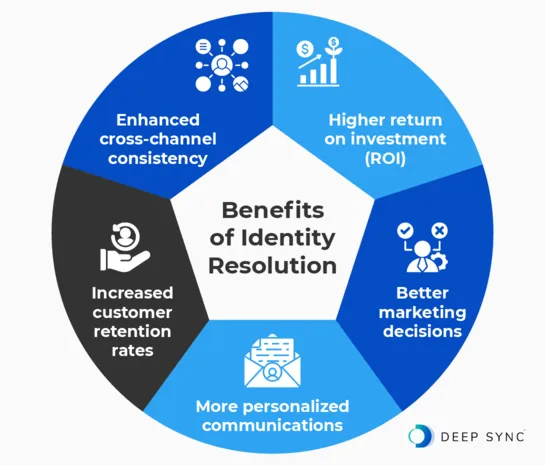
Better marketing decisions. When you fully understand individual customers and your audience as a whole, you can make more well-informed decisions based on these insights. From selecting the channels you'll use to reach your audience to tailoring your products and services to their needs, you can base your strategy on data instead of assumptions or trial and error.
More personalized communications. Customer expectations are at a record high, with 79% wanting brands to demonstrate that they understand and care about their unique needs before even making a purchase. By creating unified customer profiles, you can deliver more relevant, personalized marketing messages to your customers that encourage them to support your business.
Increased customer retention rates. Through these more personalized communications and interactions, you'll improve customer retention. Customers are more likely to show loyalty to a brand when they feel valued as individuals and receive messages that speak to their unique pain points.
Enhanced cross-channel consistency. Display the right messages to the right customers at the right time on the right channels. With a unified view of each customer, you can target them with cohesive, relevant messages across channels instead of serving them different messages on each channel they use to interact with your brand.
Higher return on investment (ROI). By avoiding duplicate messaging and optimizing your marketing campaigns based on your customers' unique preferences and needs, you can improve your return on marketing investment. Plus, when you retain customers through more personalized marketing efforts, you'll spend less on customer acquisition costs, boosting your ROI even more.
Between offering a more tailored customer experience and making it easier to get the most out of your marketing spend, identity resolution offers a win-win situation for your audience members and your team.
Identity resolution use cases
Wondering what identity resolution looks like in practice? Explore these identity resolution use cases that you can leverage to upgrade your marketing strategy.
Digital-to-direct mail retargeting
Typical retargeting occurs entirely online. A user visits your website without making a purchase, and you serve them ads that encourage them to revisit your site and follow through.
With identity resolution, you can move this process offline. Let's say a user browses a piece of furniture on your company's website but leaves without buying it. Instead of serving them a generic online display ad, you can use identity resolution to capture their Mobile Ad ID (MAID) or IP address and resolve it back to their verified postal address.
Then, you can send them a postcard or catalog promoting similar products. This physical reminder of your business can motivate them to return to your site and finally make that purchase.
Household-level attribution
When you serve ads to households with multiple members, the person who views the ad may not necessarily be the one who converts. For example, you may serve a Connected TV (CTV) ad promoting your water park. A child in the household may see this ad on the living room TV and tell her parents about it, prompting her mom to book the trip on her laptop.
Typically, this conversion would be attributed to organic traffic, and you would never know that the child viewing the CTV ad was the origin. However, with identity resolution, you can link both the CTV ID and the laptop's IP address to the same household. That way, you can group different household devices and better understand what causes each household to convert.
CRM data translation for social activation
Imagine you're trying to target your top customers with a social campaign. However, when you upload your customer data to Meta, your match rate is only 30%. Likely, more than 30% of your top customers are on Instagram or Facebook, but the email addresses associated with their accounts may be different from the ones you have stored in your CRM.
You can solve this problem through data translation. When you send a data provider the names and old email addresses you're trying to use for targeting, they can match this information to other customer data and return the correct hashed email addresses and MAIDs associated with those people. Then, you can upload your new translated file to Meta, allowing you to improve match rates and serve ads to more customers.
Common identity resolution challenges
While identity resolution can help marketers better understand their customers and personalize their efforts, the process still has its challenges. Here are a few roadblocks you may encounter and how Deep Sync can help you work through them:
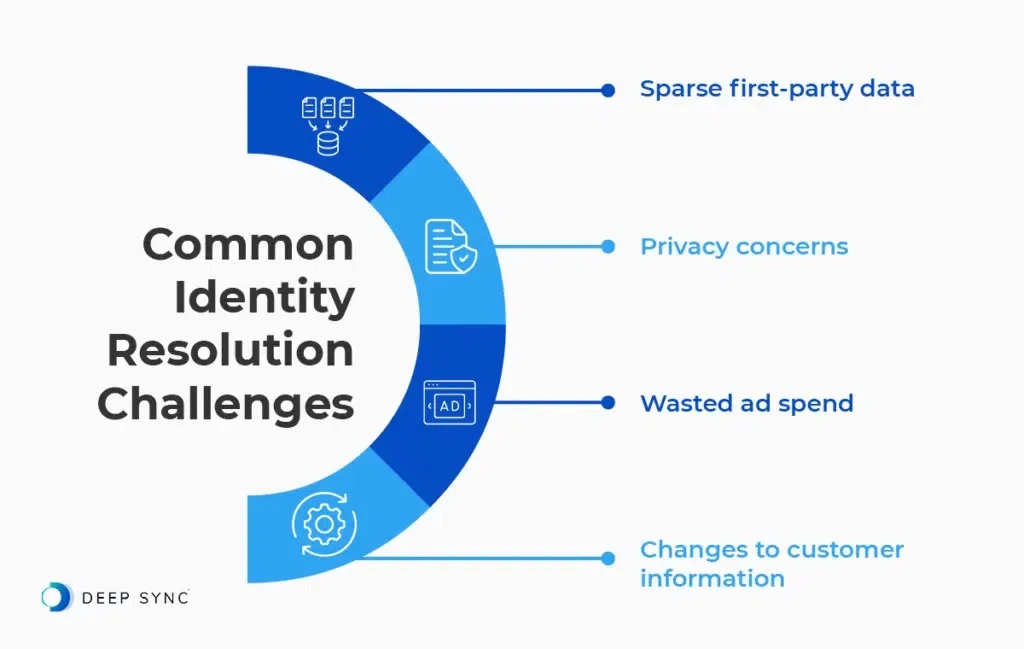
Sparse first-party data. The identity resolution process begins with your company's first-party data. However, many brands only have select pieces of fragmented offline data, making it difficult for digital-first identity graphs to leverage. That's why Deep Sync's identity graph is anchored to offline data. Even if your brand only has a list of customer names and physical addresses, we can match this offline information to corresponding digital identifiers so you can take your targeting online.
Privacy concerns. While your marketing team may be ready to invest in identity resolution, your IT and legal teams may be hesitant to export customer data files to a third party. Additionally, some customers may prefer that you not use their information in this way. Deep Sync is fully equipped to handle these concerns by offering cloud-based identity resolution, accepting opt-outs from every state, committing never to sell or share your proprietary customer files, and assigning an anonymous ID to each customer.
Wasted ad spend. Some identity vendors with high match rates rely on probabilistic matching to hit those numbers. Probabilistic identity resolution can lead to hallucinations or false connections, causing brands to waste ad spend by targeting the wrong people. Since Deep Sync uses deterministic matching, you can be confident in the matches found through our identity graph and allocate resources more strategically.
Changes to customer information. Every year, people move, change their names, switch jobs, buy new phones, or make other life changes. If your identity graph doesn't keep up with these updates, you may end up sending direct mail to old addresses or serving digital ads to abandoned devices. Deep Sync's identity graph updates weekly to ensure you resolve customer identities using the most accurate, up-to-date information possible.
Identity resolution best practices
Your identity provider will handle the ins and outs of the identity resolution process, but that doesn't mean you lack agency. In fact, it's up to you to prepare your data and team for identity resolution to maximize your results. This process may include:
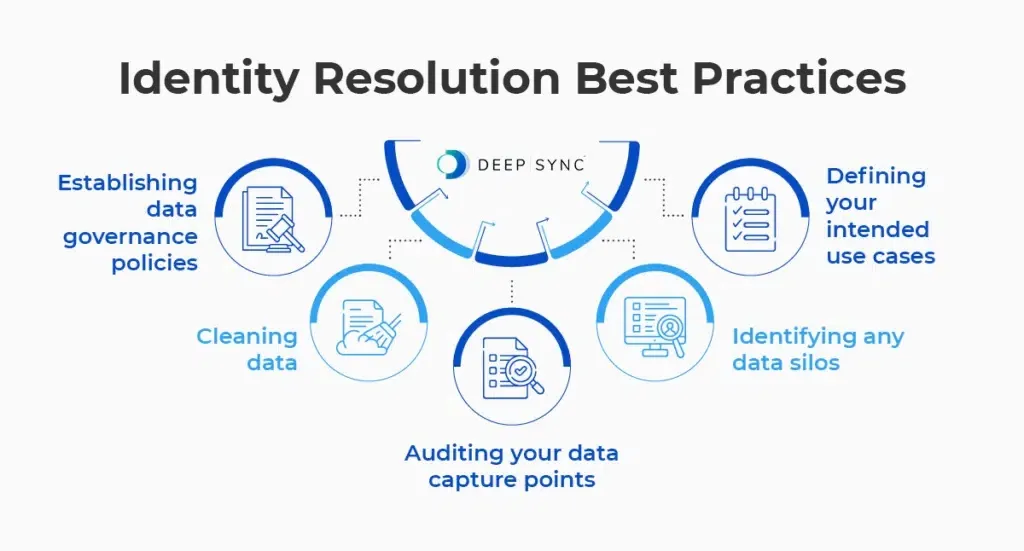
Establishing data governance policies. Data governance refers to how your company organizes and handles customer information. By implementing data entry standards, assigning data management roles and responsibilities, and implementing data audits, you can be confident that the data you use for identity resolution is secure and properly managed.
Cleaning data. In addition to procedures for managing your data, you should implement data hygiene best practices to prepare this information for identity resolution. You may resolve any errors, suppress extraneous data, and validate your data externally.
Auditing your data capture points. Start thinking about the data you need for effective identity resolution. While you don't want to ask for unnecessary information, review your web forms, point-of-sale prompts, and lead magnets to identify opportunities to broaden the information you collect.
Identifying any data silos. Even if you have enough information about your customers, these data points may be scattered across different systems and contain inconsistencies, making it difficult to use them for identity resolution. Pinpoint which solutions contain customer data, which pieces of information each has, and how you can connect these systems to create a single source of truth.
Defining your intended use cases. Before you embark on the identity resolution process, sit down with your team to determine what you're looking to get out of the process. Then, bring these goals to your identity provider to ensure they prioritize the matches you're looking for.
To continue deriving value from identity resolution, make these steps an ongoing, repeatable process. Take note of what procedures helped you get the most out of the identity resolution process, and work with your team to identify any changes you can make to your approach in the future to further improve your results.
How does Deep Sync's identity resolution process work?
First and foremost, Deep Sync uses a deterministic matching process to accurately attribute identifiers to specific customers and build unified customer profiles. These identifiers include full names, postal addresses, email addresses, phone numbers, IP addresses, CTV IDs, mobile IDs, and UID2s.
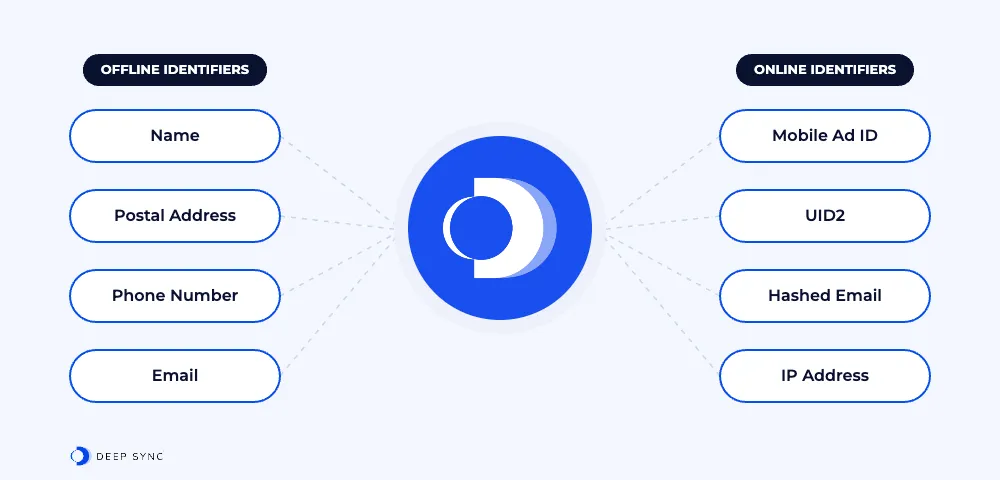
We use our exclusive persistent identifier, the Deep Sync ID, to link offline data, like name, postal address, and phone number, to online data, like MAIDs, UID2s, hashed emails, and IP addresses. This allows us to resolve your records to singular, unified customer profiles. So, you can be confident that the resulting customer profiles are accurate and ready for your team to leverage in its marketing strategy.
Why is Deep Sync the best choice for identity resolution services?
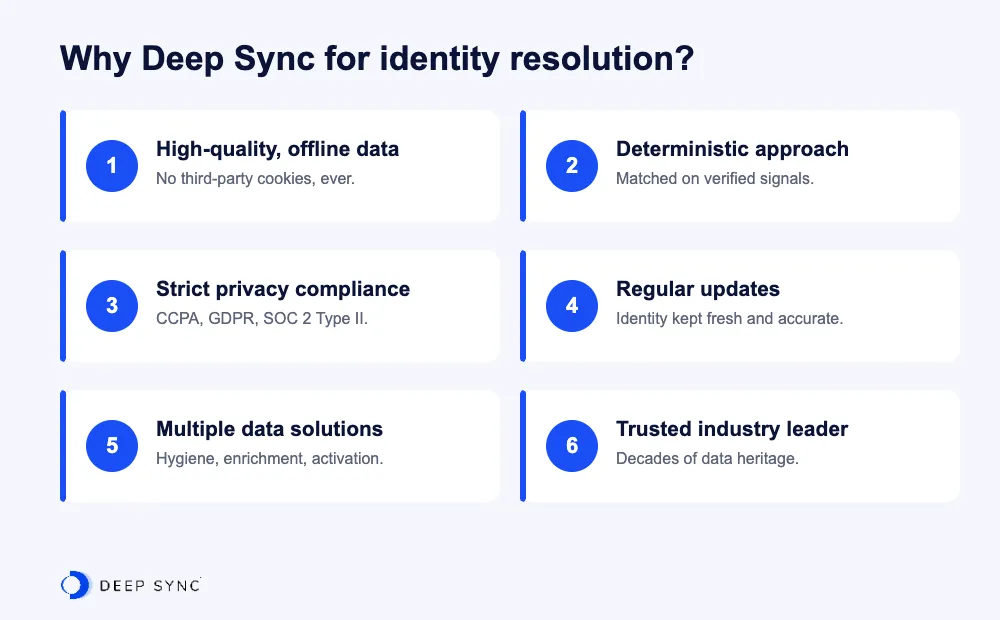
With various data providers or platforms to choose from, why should you trust Deep Sync for your identity resolution needs? Deep Sync's identity resolution services stand out from the crowd for the following reasons:
High-quality, offline data sources. Because our data comes from high-quality, offline sources, third-party cookies have never been part of our compilation methodology. Our identity spine covers 97% of U.S. consumers and is powered by highly exclusive postal data updates, making our dataset one of the most accurate in the industry.
Deterministic approach. Our deterministic offline data is connected to billions of digital identifiers, including email addresses, mobile IDs (MAIDs), IP addresses, and more, enabling offline-to-online identity resolution. We apply these identifiers at the individual and household levels, so you can target individual customers or their entire household.
Regular updates. We update our identity spine weekly to ensure it's accurate. That way, you can keep up with customers who have moved, gotten new phone numbers, or gone through other life changes without missing a beat.
Trusted industry leader. With close to four decades of experience, our team has paved the way for data-driven marketing solutions. Our data powers about 5% of all U.S. mail sent each year. In addition to working with agencies and brands directly, we license our own data assets to many of the nation's leading data providers.
Strict privacy compliance. We observe all federal and state-level privacy laws and regulations. We accept and process opt-out requests from consumers in all states, regardless of whether it's required by state law, so you can maintain trust with your customers and avoid targeting consumers with unwanted messages.
Multiple data solutions. In addition to our identity resolution services, we offer data hygiene, enhancement, customer profiling, and digital targeting solutions to strengthen the usability, accuracy, and completeness of your first-party data even further. Reach your audience via social media advertising, programmatic advertising, Connected TV advertising, email marketing, and direct mail, all by working with the same data team that understands your business and its needs.
By partnering with the industry leader in deterministic identity, you can unlock unparalleled customer insights and take full advantage of Deep Sync's premier data assets and solutions for better audience targeting and reach.
Simplify your identity resolution process with Deep Sync
Customers interact with your brand in various ways, from your website to social media to brick-and-mortar shopping. And, outside of your business, your customers possess different qualities that make them unique.
Identifying exactly who your customers are is the key to more successful, personalized marketing. By unifying online and offline identifiers, you can create cohesive customer profiles to customize your messages and interactions, focus your marketing efforts, offer a better customer experience, and boost your marketing ROI.
As the industry leader in deterministic identity with close to 40 years of experience in data quality, hygiene, and identity resolution, Deep Sync can supercharge your identity resolution efforts. If you're ready to get started with identity resolution, book a strategy session so we can discuss our services and your business's needs.
Build people-based marketing on accurate identity.
See it on your own data, run a free match test and we'll show you how much of your file resolves to real people and households.
Julia is Director of Product Marketing at Deep Sync, specializing in identity resolution, customer data, audience activation, and go-to-market strategy. She helps brands turn complex data into actionable insights that power better marketing, personalization, and customer engagement.
Let's connect →