

The Role of Identity in Audience Activation
Today’s advertising platforms are incredibly powerful. Their optimization algorithms analyze massive datasets to improve targeting, bidding, and campaign performance. But there’s a growing problem!
When every agency relies on the same platform signals and the same optimization systems, differentiation becomes harder. If everyone uses the same inputs, the outputs begin to look the same.
For many small and mid-sized agencies, this creates a difficult reality: delivering better performance often requires better data, not just better tools.
That’s where identity-driven infrastructure becomes critical.
How Small and Mid Agencies Compete in a Data Game Built for Giants
Instead, they manage multiple clients, fast campaign timelines, and tight budgets while still being expected to deliver measurable performance improvements.
At the same time, many identity and data solutions in the market were originally designed for large enterprise organizations:
- Longer onboarding timelines
- Annual licensing models or minimum commitments
- Infrastructure requirements designed for larger organizations
- Technical integration processes that require significant resources
For agencies managing multiple campaigns and clients simultaneously, these factors can slow experimentation and make it harder to quickly test new audience strategies.
As a result, many smaller agencies are looking for identity solutions that deliver similar capabilities but with faster activation, simpler integration, and more flexible cost models.
Limits of Platform Data
Advertising platforms provide powerful optimization capabilities, but they only see part of the customer journey. Most platforms operate within their own ecosystems and rely primarily on signals generated inside those environments.
As a result, many valuable data signals remain outside the platform’s visibility, including:
- Offline purchasing behavior
- Household-level relationships
- Cross-channel identity signals
- First-party CRM and customer data
Without identity infrastructure to connect these signals, marketers often operate with an incomplete view of their audiences.
In the broader identity ecosystem, scale is often highlighted as a key differentiator. Many providers promote massive identity graphs containing billions of profiles as proof of reach and coverage.
But size alone does not guarantee accuracy.
The population of the United States is roughly 335 million people, yet some identity graphs claim billions of profiles. In many cases, those additional profiles represent fragmented identities, the same individual appearing multiple times across devices, addresses, or data sources.
For agencies focused on campaign performance, what matters most is not the size of the identity graph but the accuracy of the identities it represents.
When identity accurately connects signals to real individuals and households, agencies can build more reliable audiences, improve targeting precision, and measure campaign performance with greater confidence
Better identity leads to better targeting, clearer insights, and stronger campaign outcomes.
Identity Should Connect Data, Not Add Complexity
Identity-driven infrastructure helps agencies make fragmented customer data usable for audience creation, targeting, and activation. By linking signals such as first-party customer data, real-world behavioral activity, cross-channel identifiers, and household relationships, agencies gain a clearer and more reliable view of their audiences.
When identity signals are accurate, agencies can build more precise audiences, improve measurement, and activate campaigns with greater confidence.
Historically, however, identity solutions often required complex integrations, long onboarding timelines, and enterprise-scale infrastructure designed for large organizations with dedicated data teams.
Today, modern identity platforms are evolving toward a simpler model focused on speed, accessibility, and operational flexibility. For agencies managing multiple clients and fast campaign cycles, the most valuable solutions are those that activate audiences quickly, integrate easily with existing workflows, and allow teams to scale data strategies without heavy infrastructure or long-term commitments.
Deep Sync One: Identity Built for Agency Speed
Deep Sync One gives agencies access to identity-driven audience activation without the complexity of traditional enterprise identity platforms.
Instead of lengthy onboarding processes or enterprise contracts, the platform provides a plug-and-play approach that allows agencies to onboard first-party data, match it against Deep Sync’s identity graph, and quickly activate identity-based audiences within their existing campaign workflows.
With Deep Sync One, agencies can:
- Audience Builder: Create identity-driven audiences using first-party data, behavioral signals, and marketplace datasets.
- Lookalike Modeling: Expand high-performing audiences by identifying new users with similar identity and behavioral characteristics.
- Customer Insights & Analysis: Understand audience composition and behavioral patterns to inform campaign strategy.
- Data Onboarding and Matching: Agencies can onboard first-party data into Deep Sync One and match it against Deep Sync’s identity to support audience creation and activation.
- Fast Audience Activation: Launch audiences in hours instead of weeks, enabling faster campaign testing and optimization cycles.
Deep Sync One also removes many of the financial barriers agencies encounter with traditional identity solutions. The platform requires no sign-up fees, no long-term contracts, and no minimum commitments, allowing agencies to activate identity-based audiences only when campaigns require them.
This flexible model allows agencies to test identity-driven strategies, experiment with audience segmentation, and scale successful campaigns without committing to enterprise-level infrastructure.
Identity Solutions for Agencies: What to Look For
While many identity platforms were built for large enterprises, newer identity infrastructure models are designed for speed and flexibility. The comparison below highlights the key differences:
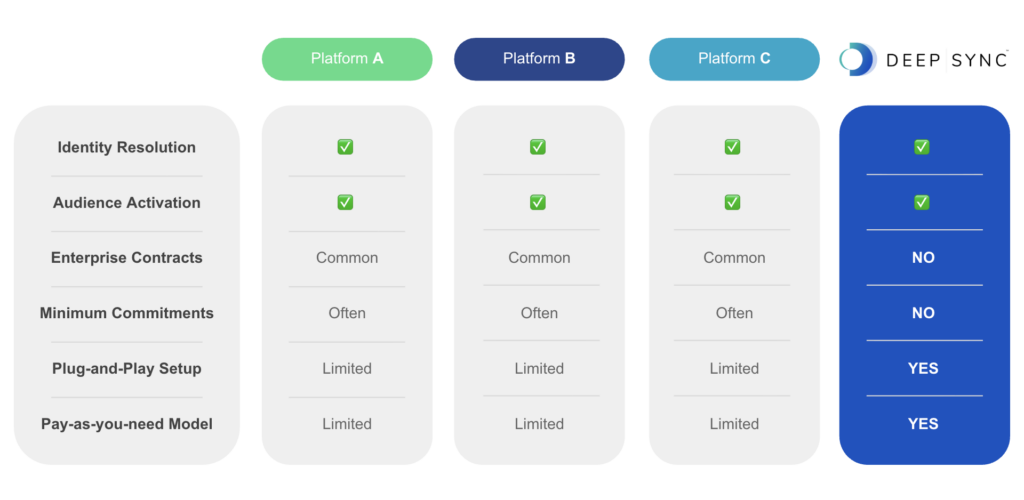
Deep Sync One enables agencies to activate identity-driven audiences quickly without enterprise complexity.








0 Comments