
Why more data hasn’t translated into better execution, and where it breaks down before voters are ever reached
Political campaigns have never had more data. Voter files are richer, media spans CTV, streaming, and programmatic environments, and targeting has become increasingly granular and personalized. On paper, campaigns should be more precise and more effective than ever.
But that’s not what’s happening, because in practice, most of that potential breaks long before a campaign ever reaches a voter.
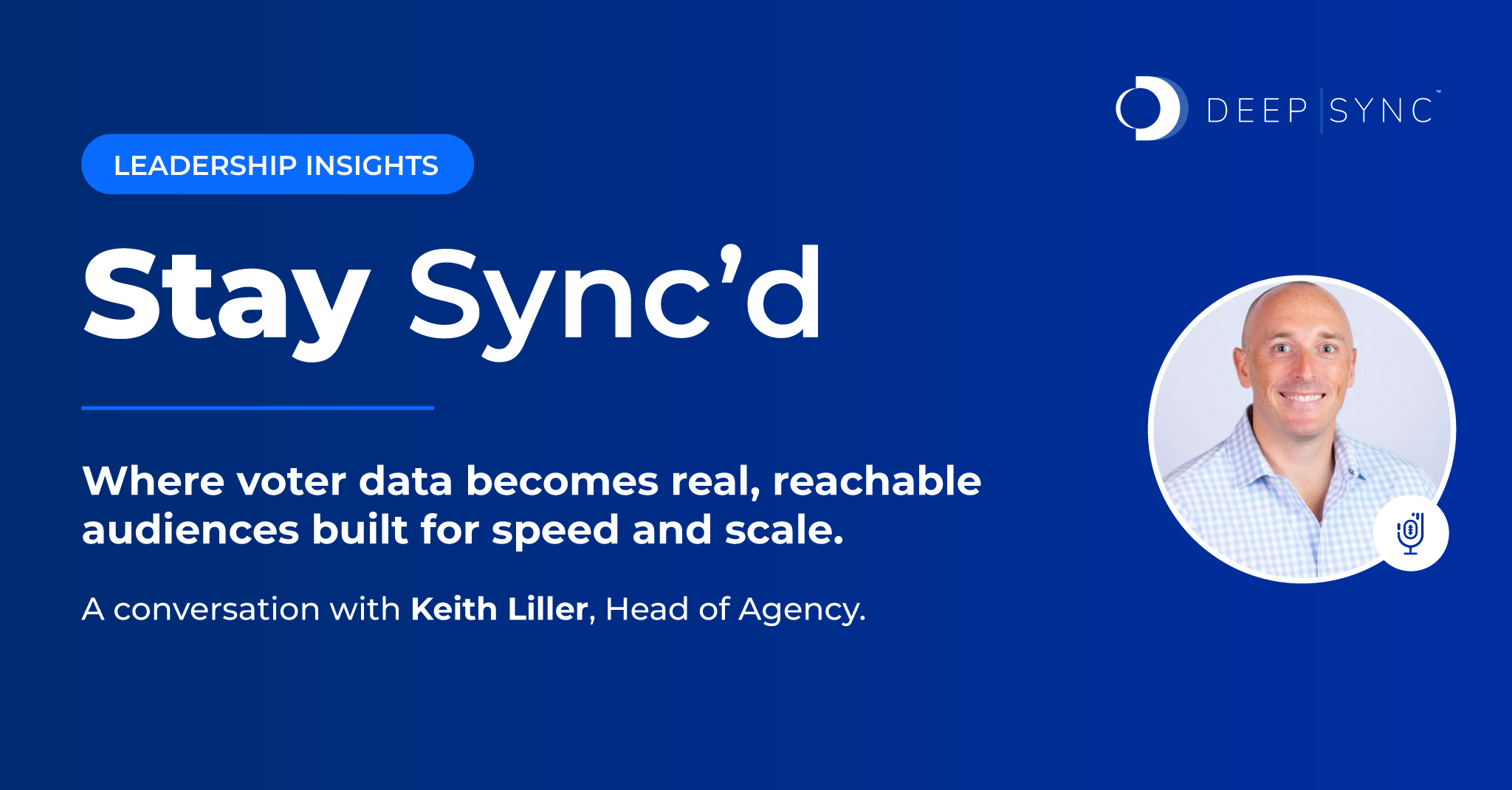
In this edition of Stay Sync’d, Keith Liller, Head of Agency Development at Deep Sync, offers a perspective that challenges one of the industry’s most common assumptions: that political campaigns are purely data-driven. The reality, he suggests, is more complicated. What has evolved over the past decade is the promise of precision, not necessarily the ability to execute on it.
The adoption of cross-screen activation has allowed campaigns to shift from broad demographic targeting to more exact, 1:1 targeting. In the political realm, that matters. You need real people in precise places,” he said. “But that doesn’t mean everything is working as effectively as it should.”
The illusion of being “data-driven”
Campaigns today operate under the assumption that more data leads to better performance. But that assumption depends on something far less visible and far less discussed: whether that data can actually be translated into usable, addressable audiences.
That’s where the breakdown begins: Campaigns don’t have a data shortage, They have a data usability problem.
This problem rarely appears in strategy discussions or planning decks. It tends to surface only when campaigns attempt to activate voter data across platforms, when the theoretical value of a voter file is expected to become operational.
That transition, however, is where things begin to break.
“Sure, you may have the voter file,” he explained, “but if you can’t quickly and easily use that data with pinpoint accuracy across channels, you’re behind.”
Liller describes this moment as a “handshake” between campaign data and the digital ecosystem. In theory, that handshake should be seamless. In practice, it is where much of a campaign’s potential is lost, not because of a single failure point, but because of a series of structural gaps, missing identifiers, incomplete records, and inconsistencies that prevent data from translating into matchable, scalable audiences.
By the time those gaps become visible, they are already impacting performance through lower match rates, reduced addressability, and limited reach.
Identity is the layer most campaigns skip
When performance begins to lag, many campaigns respond by adjusting targeting strategies, optimizing media, or refining creative. But as Liller points out, those changes often come too late, because they do not address the root issue: The problem is not performance. It’s identity.
“Whether it’s enriching data with more PII, appending attributes, or improving data hygiene, making sure your data is complete and accurate is paramount,”
Without identity resolution, campaigns are not consistently reaching the same voter across platforms. Instead, they are working with fragmented signals that may or may not resolve into a single, persistent individual. That fragmentation limits scale, introduces inconsistency, and ultimately reduces the effectiveness of both targeting and measurement.
When identity is addressed earlier in the process, before data is onboarded into platforms, the impact is immediate. By enriching data prior to onboarding, you’re going to significantly improve your match rates and your ability to reach voters at scale, Liller said.
The shift is not just technical. It changes how campaigns operate, moving identity resolution from a downstream fix to a foundational layer within the data infrastructure.
The cost of delay
Time introduces another layer of complexity that campaigns often underestimate. Political campaigns operate within compressed decision windows, where even small delays can have meaningful consequences.
For years, it has been standard for voter data onboarding to take 72 hours or more. That timeline has not kept pace with the speed at which modern campaigns need to operate.
“You upload a file on Sunday, but it doesn’t get into the platform until Wednesday,” Liller said. “By then, you could easily be targeting individuals who already went in to vote or mailed in a ballot.”
The campaign continues to spend, and performance metrics may not immediately reflect the issue, but the opportunity has already passed. Faster activation is not simply a matter of efficiency; it directly affects the relevance of the audience being reached and the effectiveness of the campaign.
When onboarding timelines are reduced from days to hours, the impact becomes tangible. Campaigns can respond in near real time, adjust audiences based on evolving voter behavior, and reach individuals while they are still persuadable.
In practice, as seen in a Deep Sync case study with a political agency, applying an identity-first onboarding approach reduced activation timelines to hours, often completing matching and onboarding in under one hour, while increasing addressability across key programmatic platforms by ~25% on average, and up to ~120% in live campaigns.
In political campaigns, that difference isn’t incremental, it defines whether data can actually drive performance.
What changes heading into 2026
As campaigns approach the 2026 midterms, the environment is becoming more complex and more demanding. Campaigns are navigating an expanding mix of channels, increasing fragmentation, growing reliance on AI-driven optimization, and ongoing pressure on privacy and signal loss.
All of these dynamics increase the importance of having data that is accurate, connected, and usable from the start.
“If you’re starting from an incomplete dataset, outcomes will suffer, especially when it needs to move fast or scale. If the foundation is strong, the rest will follow.”
The campaigns that succeed will not be the ones with the most data, but the ones that can transform voter data into addressable audiences and activate it efficiently across channels.
Closing the gap
In political advertising, the gap between strategy and execution is rarely obvious. Campaigns are thoughtfully planned, targeting is carefully defined, and the intent is clear.
Yet between the voter file and the moment an ad is delivered, something is lost. Until that gap is addressed, campaigns will continue to underperform, not because they lack sophistication, but because their data never fully becomes actionable.
Political campaigns do not fail because they lack data. They fail because that data never becomes usable!
As campaigns become more dependent on identity resolution, data quality, and cross-platform activation, the ecosystem’s structure becomes increasingly important. No single solution can fully address the complexity of modern political advertising, which is why partnerships are playing a larger role in how campaigns move from data to execution.
For Liller, the value of collaboration is rooted in alignment. As an example, both Deep Sync and MiQ, a global programmatic media partner, are focused on improving data usability, accelerating activation, and building solutions designed specifically for political campaigns. Bringing those capabilities together allows campaigns to operate more efficiently and with greater precision.
At a practical level, this means simplifying what has become an overly complex system.
“Anyone in digital media who knows me has likely heard me say that the ecosystem has gotten overly complex,”
By automating the enrichment and delivery of first-party voter data, and creating a more seamless flow from identity resolution to audience creation and activation, campaigns can move faster without requiring deep technical expertise.
In an environment where timing, scale, and precision all matter, that simplicity becomes more than an operational advantage, it becomes a strategic one. Because the gap between voter data and real-world execution isn’t theoretical; it is where match rates are lost, where audiences fail to scale, and where campaigns underperform before they even begin.
Rather than forcing campaigns to navigate fragmentation, that model reduces it. Activation becomes faster, audiences become more addressable, and performance becomes more consistent and measurable, built from the start on real, identifiable voters rather than fragmented signals.
Stay tuned for the next edition of Stay Sync’d, where we’ll bring in a special guest from MiQ to explore how these challenges surface in real-world media execution, platforms, and campaign performance.
MiQ is a global advertising technology company that works with advertisers and agencies to enhance their campaign performance through data- and technology-driven programmatic solutions. Founded in 2010 in London, UK, MiQ today operates out of more than 33 offices worldwide. The company combines data science, artificial intelligence, and proprietary technology to help its clients make more informed decisions, optimize their digital campaigns, and maximize their return on investment (ROI). As part of this offering, MiQ developed Sigma—its industry-recognized and award-winning AI-powered ad technology—which integrates multiple data sources and signals to provide a more comprehensive view of audience behavior. With this approach, MiQ enables brands and agencies to execute strategies that are more efficient, measurable, and results-oriented.

Keith Liller has spent nearly 15 years in ad tech, working at the intersection of data, identity, and activation. At Deep Sync, he leads agency partnerships, helping organizations navigate the complexities of turning fragmented data into usable, scalable audiences across modern marketing and political environments.
Connect with Keith on LinkedIn!
Continue the conversation
In a previous edition of Stay Sync’d, Cory Davis explored how identity is becoming the foundation for modern marketing and why everything downstream depends on it.
Read the full piece: Identity as Infrastructure: Why Marketing’s Next Era Depends on Foundational Identity
Related topics:
Digital Advertising for Upcoming Political Campaigns: Onboarding Tips for Agencies
From Voter Files to Activation in Hours: How Push Digital Group Scaled Match Rates









0 Comments