

Success Use Case
Segment:
Grocery & Mass Merchants
Challenge:
Limited loyalty participation, high in-store transaction volume, low customer visibility
Solution:
Transaction Matching as a unifying identity layer
Outcome:
Transaction Matching resolved over 70% of in-store transactions to real individuals and households.
Grocery chains generate enormous transaction volume, but many still operate with partial customer visibility. Loyalty and CRM systems capture only a subset of shoppers, leaving a significant share of in-store spend effectively anonymous. As a result, analytics stop at the transaction level, household behavior fragments across systems, and growth decisions are made without a complete view of the customer.
This use case highlights how one national grocery chain addressed that challenge by introducing identity at the transaction level, without relying on increased loyalty enrollment or changes at the register.
Transaction matching for grocery brands addresses this gap by introducing identity at the transaction level — even when loyalty participation is limited.
Loyalty Gap in Grocery Analytics
For years, the chain relied on loyalty and CRM data as its primary source of customer insight. Like many value-focused brands, loyalty participation was limited. Most shoppers completed transactions without identifying themselves in any persistent way.
Purchases were captured at the register, but customer identity was not. As a result, customer profiles could not persist across visits, household shopping behavior was fragmented, and analytics remained anchored to individual transactions rather than connected customer history.
In practice, most in-store spend could not be tied to a real person or household. What looked like robust transaction data masked a deeper visibility problem.
Identity Beyond Loyalty
Why Loyalty Alone Was Not Enough
To close the visibility gap, the grocery chain introduced Deep Sync’s Transaction Matching as an identity layer across its in-store transaction data. Rather than relying on loyalty as the sole identifier, Transaction Matching uses multiple privacy-safe identity signals to resolve transactions to real individuals and households. This approach allows grocery brands to understand who is buying — even when loyalty participation is limited without changing the in-store experience or increasing enrollment requirements.
Before Transaction Matching was applied, customer insight depended almost entirely on CRM and loyalty data. Like many value-focused grocery brands, loyalty participation was limited, leaving most in-store transactions effectively anonymous. Purchases were captured at the register, but customer identity was not, which prevented the business from building persistent customer and household understanding.
In practice, this meant:
- Customer profiles could not persist across visits
- Household behavior was fragmented across systems
- Analytics stopped at the transaction level
- The team could not measure purchase behavior over time
- Most in-store spend could not be tied to a real individual or household
At the register, purchases were captured. Customer identity was not.
Transaction Matching changed that dynamic by introducing identity at the transaction level. Instead of depending on a single identifier, the approach layered multiple privacy-safe signals to uncover how much customer and household identity already existed within transaction data — even without broad loyalty participation.
Transaction Matching combined:
- Available loyalty data
- Privacy-safe transaction-level signals
- Store-level geographic and catchment intelligence
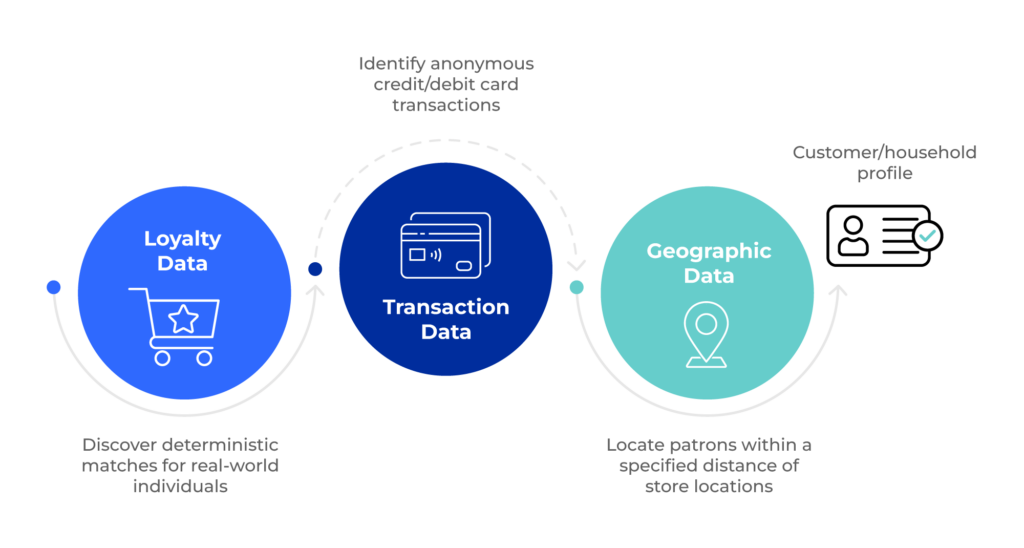
The objective was simple: see how much identity already existed once loyalty was no longer the only key.
Once Transaction Matching was applied, identity coverage changed immediately and clearly. The results were immediate and material. Over 70% of in-store transactions were resolved to real individuals and households, dramatically expanding identity coverage without requiring changes at the register or increased loyalty participation.
This demonstrated that:
- A majority of transactions already contain usable identity signals
- Loyalty alone is not required to achieve meaningful customer visibility
- Identity coverage can scale using privacy-safe, non-disruptive methods
From Partial Visibility to Majority Coverage
Even at its lowest point, more than half of all transactions were resolved to real people or households.
At its peak, identity coverage approached 70% without requiring increased loyalty enrollment or changes at the register.
That threshold matters. Once a majority of transactions are tied to identity:
- Customer and household profiles become viable
- Purchase frequency can be measured
- Repeat behavior becomes visible
- Analytics move beyond isolated transactions
Transactions stop being anonymous events. They become connected customer history.
The Real Outcome
This use case demonstrates a critical truth for grocery organizations: You don’t need perfect loyalty coverage to understand your customers. You need an identity layer that works beyond loyalty: filling in gaps, correcting inaccuracies, and adding context. By combining loyalty, card, and geographic signals, Transaction Matching unlocks identity already present in transaction data – identity that traditional systems leave behind.
This grocery chain did not just “increase a match rate.” It changed what was measurable.
Anonymous spend became attributable. Household behavior became observable. Customer insight moved from assumption to evidence. That is the commercial value of identity.
If most of your transactions still cannot be tied to a real customer, your analytics are operating on partial truth. Transaction Matching turns transaction data into identity — and identity into intelligence.
Because knowing what was bought is no longer enough. Knowing who is buying is what changes the business.
Stop analyzing anonymous transactions. Start operating on customer identity. See how Deep Sync’s Transaction Matching turns in-store transaction data into real customer and household intelligence, even when loyalty participation is limited. Learn more!









0 Comments