

Smart companies know that first-party data is a differentiator. But, they also know that first-party data is rarely enough on its own, even for those companies with vast data assets. Incomplete profiles, stale data, and narrow areas of expertise often limit what teams can do with their data. That’s where data collaboration becomes essential.
Data collaboration is the secure sharing, combining, and analysis of data across entities to enable a more complete picture and deeper insights, thus powering more effective workflows. Proper data collaboration also needs to be privacy-safe. That’s where things get tricky: how do you enable data collaboration while adhering to strict safety standards, often with minimal data movement? Well, clean rooms have been touted as the solution for this, but is that really the case? And are clean rooms the main option for privacy-safe data collaboration? Let’s dive deeper and see.
What Is a Data Clean Room?
A data clean room is a secure, privacy-safe environment that enables multiple parties to collaborate on data without exposing raw personally identifiable information (PII).
Rather than sharing raw datasets, clean rooms rely on controlled access, encryption, and aggregated outputs. This approach enables organizations to match datasets securely, analyze overlaps and performance, and measure outcomes across partners—all while protecting consumer privacy and maintaining compliance.
In short, clean rooms are designed to support collaboration without compromising trust.
But here’s the shift: clean rooms are no longer the strategy. They’re one of several ways to enable privacy-safe data collaboration—and they only work when identity is strong.
Why Privacy-Safe Data Collaboration Matters More Than Ever (and Where Clean Rooms Fit)
Data collaboration has moved from “nice to have” to essential—not because clean rooms suddenly became trendy, but because the entire data ecosystem is being rewritten around privacy and control.
The decline of third-party cookies has forced organizations to rethink addressability and audience strategy. Retail media networks are expanding at record speed, creating massive opportunities—and new challenges—for measurement, attribution, and shared ROI.
At the same time, cloud-native ecosystems like Snowflake and Databricks now enable collaboration without data movement—a path many teams prefer to traditional clean room setups. Add increased data fragmentation and rising expectations for privacy-safe measurement, and the outcome becomes clear: collaboration is no longer optional.
Today, organizations rely on privacy-safe data collaboration to power:
- Measurement and attribution
- Audience insights and segmentation
- Retail media performance and partner data sharing
- Closed-loop measurement across online and offline channels
- Native app collaboration inside cloud environments (Databricks, Snowflake, BigQuery, etc.)
- Privacy-safe file intake and delivery when cloud or clean rooms aren’t viable
- Identity resolution for activation across environments
Clean rooms are one solution—not the solution. Identity is the connective tissue that binds them all.
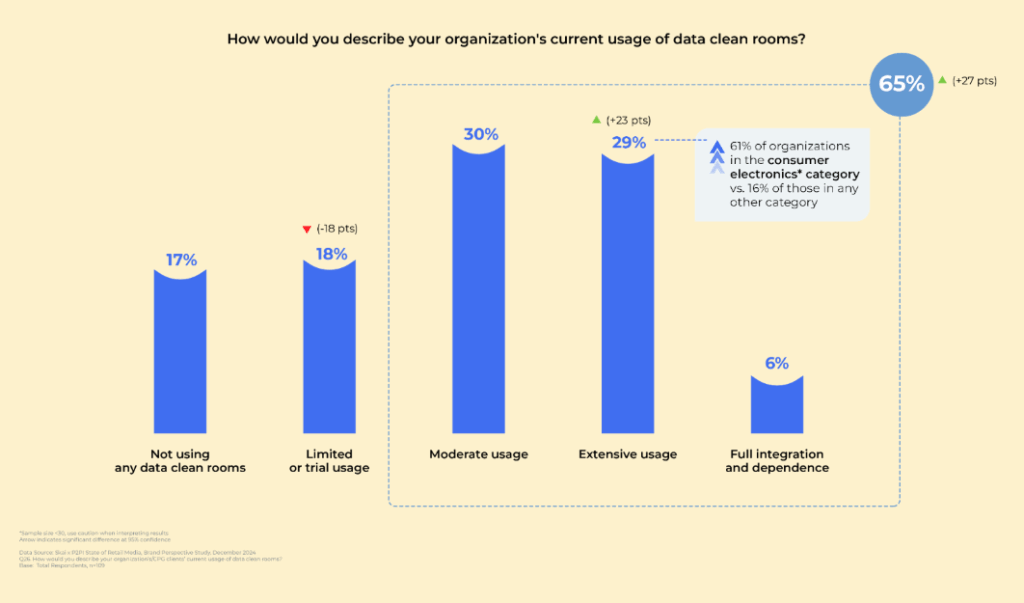
In retail media, about 66% of teams say they already use clean rooms in some form. Source: SKAI
Why Clean Rooms Don’t Work Without Identity
Clean rooms are a core component of many modern data strategies. As privacy regulations evolve, third-party cookies disappear, and retail media continues to accelerate, organizations are increasingly turning to data clean rooms to collaborate safely and unlock insights from first-party and partner data. Adoption is rising fast—but performance varies widely.
The problem isn’t the clean room. The problem is the identity that enters it. And the reason isn’t the clean room technology itself. It’s what happens before data ever enters the clean room.
Organizations struggle due to:
- Low match rates across datasets
- Long onboarding and integration timelines
- Operational complexity
- Inconsistent identity signals
- Identity fragmentation across cloud, CRM, ad platforms, and retail media
Why Many Clean Room Initiatives Fall Short
The most common clean room challenges are not related to the technology itself. Instead, they show up as low match rates across datasets, long onboarding and integration timelines, operational complexity, and inconsistent identity signals.
Clean rooms don’t fail because of technology. They fail because identity is fragmented, inconsistent, or inferred.
At their core, clean rooms depend on identity resolution to match records across datasets. When identity is weak, matches are incomplete, attribution becomes unreliable, and insights lose credibility. Even the most advanced clean room cannot compensate for poor identity inputs.
Why Identity Is the Real Foundation of Clean Room Performance
Many solutions rely on probabilistic identity, using modeled assumptions to connect signals across devices or datasets. While probabilistic approaches can be useful in certain contexts, they introduce uncertainty—especially for enterprise measurement, attribution, and partner collaboration.
Deterministic identity is the power source. It provides verified, person-level resolution based on validated identifiers, enabling consistency and confidence across systems.Clean rooms perform best when identity is accurate, consistent, privacy-safe, and interoperable across platforms. Without this foundation, clean room outputs are limited—regardless of how sophisticated the environment may be.
Identity is what delivers accuracy across clean rooms, native applications, and privacy-safe exchanges—not the environment itself.
Identity Before the Clean Room
Deep Sync does not replace clean rooms. We make every collaboration method—clean rooms, native apps, file delivery—work better.
Deep Sync operates upstream, preparing identity before data enters any collaboration environment. By resolving identity deterministically, standardizing records, enriching signals, and anchoring them to a trusted person-level ID, we enable interoperability and accuracy everywhere collaboration happens.
When identity is clean, every downstream tool performs better—regardless of which one you choose.
How Strong Identity Simplifies and Empowers Clean Room Strategies
When identity is resolved before activation, organizations see immediate benefits. Match accuracy across datasets improves. Integration and onboarding complexity decreases. Time to value accelerates. Attribution and measurement become more reliable. Partner collaboration becomes easier and more confident.
Instead of guessing, teams operate with clarity.
Privacy Isn’t a Feature, It’s Our Foundation
Deep Sync enables identity activation without exposing raw PII, supporting privacy-safe collaboration that aligns naturally with clean room architectures. By separating identity resolution from activation and measurement, organizations gain flexibility while maintaining compliance and building long-term trust.
Start With Identity
Clean rooms are infrastructure. Native apps are infrastructure. Identity is the performance layer. When identity is deterministic, standardized, and privacy-safe, clean rooms deliver on their promise—faster activation, stronger insights, and outcomes teams can trust.
If clean rooms are a preferred tool in your data strategy, then identity is a must. Build clean room strategies on trusted identity.
Ready to Strengthen Your Data Collaboration Strategy?
Learn how Deep Sync helps teams prepare identity before data enters the clean room — reducing operational complexity, improving match accuracy, and enabling privacy-safe collaboration at scale.











0 Comments